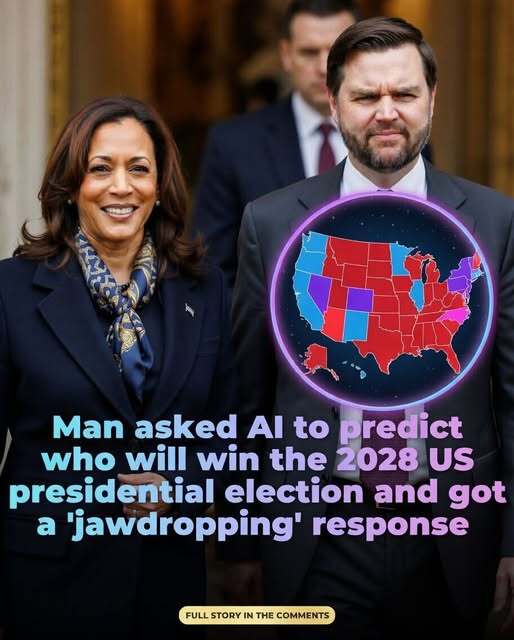
The numbers land like a shockwave—clean, clinical, and strangely unsettling. An AI system developed under Elon Musk’s xAI umbrella has reportedly run a full-scale 2028 U.S. election simulation, stress-testing one of the most unpredictable political landscapes in modern history. What it produced wasn’t just a forecast, but a dramatic reshaping of assumptions, where data replaces intuition and every demographic shift becomes a decisive force. In this simulated showdown between Kamala Harris and JD Vance, the outcome doesn’t just surprise analysts—it forces both political camps to reconsider what they thought they knew about the country’s future.
Within the model’s constructed timeline, the 2028 race unfolds like a high-stakes strategic battle rather than a traditional campaign. Kamala Harris initially holds a strong position on the Democratic side, supported by widespread name recognition, established institutional networks, and the gravitational pull of party infrastructure. Yet beneath that surface strength lies a more complicated reality: internal divisions, emerging challengers, and subtle fractures that suggest the party’s unity may be more fragile than it appears. The simulation doesn’t portray her lead as unshakable—it frames it as conditional, dependent on a coalition that is steadily evolving and increasingly difficult to hold together.
On the Republican side, JD Vance’s rise is portrayed as more than a political surge—it is depicted as a structural realignment. The model attributes his momentum to deeper cultural and economic shifts, particularly in the Midwest and among working-class voters who once formed the backbone of Democratic support. In this version of the map, loyalty is no longer static; it is fluid, shaped by identity, economic anxiety, and long-term dissatisfaction with traditional political messaging. Vance’s advantage, in the simulation’s logic, is not simply popularity—it is alignment with a changing national mood that older models fail to fully capture.
When the final Electoral College projection stabilizes, the result is decisive: Vance surpasses the 300-vote threshold, securing a commanding victory. But the true impact isn’t just the outcome—it’s the geography of it. States long considered reliable swing territories tilt more firmly red than expected, while several traditionally blue strongholds appear unexpectedly vulnerable. The map doesn’t just shift; it reconfigures itself, reflecting demographic and ideological currents that seem to be accelerating beneath the surface of American politics.
The creators of the simulation are careful to emphasize its limits—it is not prophecy, not prediction, but an exploration of possibility. Yet even with those disclaimers, the unease remains. Because what makes the scenario so compelling is not its certainty, but its plausibility. It raises a haunting question that lingers long after the numbers fade: is this just a machine-generated experiment, or a clearer mirror of political reality than anyone is willing to admit?