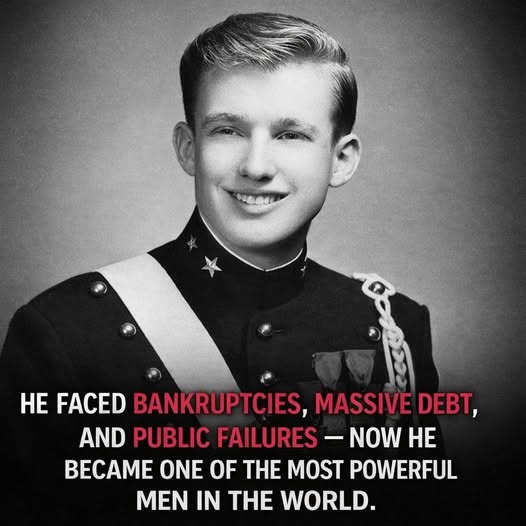
He was never supposed to lose. Not in the boardrooms of Manhattan, not in the brutal optics of American celebrity, and certainly not in the high-stakes theater of politics where perception often matters more than reality. From the beginning, Donald Trump was shaped by a worldview that treated every interaction as competition and every setback as something to be rewritten rather than accepted. In his universe, failure was never final—it was simply another angle, another headline waiting to be reframed.
Raised under the stern influence of a father who believed the world was split between winners and “losers,” Trump absorbed a philosophy of survival that blurred the line between business and warfare. Every deal became a battle of leverage. Every negotiation, a performance designed not just to win agreement but to dominate attention. Even when his empire stumbled—when casinos faltered, debts mounted, and creditors closed in—he did not retreat into obscurity or quiet repair. Instead, he leaned into spectacle, projecting confidence so loudly that it often drowned out the reality of financial strain. He courted banks, challenged skepticism, and transformed vulnerability into theater, convincing powerful institutions that his name itself carried a value too large to discard.
That same instinct for performance became his defining asset when television arrived. The screen did not just introduce him to America; it amplified him into a symbol. He mastered the language of ratings, soundbites, and controversy, turning visibility into power and repetition into influence. The persona that emerged was larger than any single business venture—a branded identity built on certainty, confrontation, and constant reinvention.
When that identity crossed into politics, it reshaped the terrain entirely. As president, he did not merely occupy office; he redefined the rhythms of political communication itself. Loyalty became currency. Grievance became fuel. Every rally, every tweet, every clash with opponents reinforced a narrative in which he was both protagonist and target, builder and besieged. To his supporters, he became a rare figure willing to challenge entrenched systems and speak in unfiltered terms. To his critics, he represented disruption of institutional norms and political restraint.
Yet through all of it—through controversy, devotion, backlash, and acclaim—one constant remained: attention never left him for long. Loved or condemned, embraced or resisted, he continued to occupy the center of the national conversation. And in that sense, his story is not simply about politics or business alone. It is about the power of spectacle in modern America, and how one figure learned to turn visibility itself into a form of permanence, ensuring that the stage is never quite complete without him.