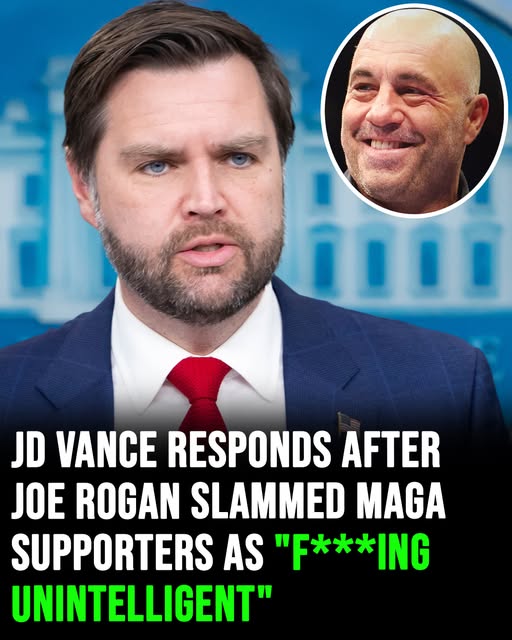
A political shockwave erupted after podcast giant Joe Rogan unleashed one of his most controversial monologues to date, igniting a fresh culture war inside an already fractured conservative landscape.
During a recent, unfiltered episode, Rogan took direct aim at the most hardline corners of the MAGA movement, dismissing segments of its base as “f***ing uninteresting and unintelligent.” The remark, delivered in his trademark blunt style, spread rapidly across social media, instantly dividing audiences between those who saw it as honest critique and those who viewed it as a betrayal from a once-friendly voice.
The reaction from political circles was immediate—and intense.
Vice President JD Vance stepped in quickly, pushing back against Rogan’s comments while attempting to defuse the escalating backlash. In a measured but pointed response, Vance joked that every political movement has its “dorks,” but insisted that reducing millions of voters to insults misses the bigger picture. He firmly defended the MAGA base, framing them as citizens committed to what he described as a mission to “save the country.”
At the same time, Vance challenged Rogan’s criticism of Trump-era policy claims, particularly around immigration enforcement. He promised he would personally “text Joe” to correct what he sees as misunderstandings, arguing that the administration associated with Donald Trump has maintained the toughest stance on illegal immigration in modern U.S. history.
What makes this clash especially explosive is not just the content of the disagreement, but the relationship behind it. Rogan has long occupied a strange space in American politics—neither fully aligned with establishment conservatism nor progressive orthodoxy, but influential enough to shape public perception across both.
Now, however, his tone toward MAGA has noticeably shifted, moving from reluctant admiration and outsider curiosity to open criticism. His recent remarks about “dorks” in the movement and skepticism toward Trump-era promises on foreign policy and immigration signal a broader reassessment—especially as global tensions, including renewed conflict involving Iran, continue to reshape political debate.
For many observers, the real story is not just Rogan’s words or Vance’s rebuttal, but what they represent: a growing tension between populist media powerhouses and populist political leaders. One speaks directly to millions through unfiltered conversation; the other governs through policy and party machinery. And between them sits a shared audience that is increasingly divided, reactive, and impossible to fully control.
As both sides double down, the rift is no longer just rhetorical—it’s becoming a visible fault line inside the modern populist movement, with consequences that could extend far beyond a single podcast episode.