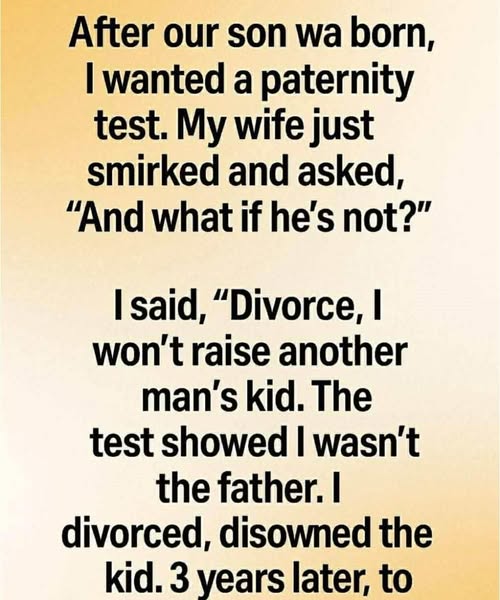
The moment he handed her the small, unassuming box, something inside their marriage quietly shattered. There was no screaming, no doors slamming, no dramatic confrontations. Just a sterile envelope, a cold paternity test, and a promise that if the results weren’t what he wanted, he would walk away. He believed he was acting with honesty. He told himself he was protecting himself from betrayal. He never imagined that the numbers on a slip of paper could lie, or that his own shadow of doubt could weigh heavier than love.
He would carry the memory of that yellow nursery for the rest of his life—not as the room where his son first slept, or where he had carefully assembled the crib with trembling hands—but as the room where he chose suspicion over trust. The pale walls, once meant to cradle hope and joy, became a silent witness to a decision born of fear rather than reason. Even as the years passed, as accolades, money, and prestige filled his life, nothing could quiet the echo of that fateful choice. The laboratory’s error became a mirror, reflecting not the fault of science, but the frailty he had carried within himself long before the envelope ever arrived.
By the time the truth finally reached him, the consequences had already taken root. His apologies arrived too late, knocking against a door that remained firmly closed. Emma had rebuilt her world from the ground up, shaping it with resilience, love, and unwavering courage. Their son grew surrounded by care and laughter, oblivious to the man who had once put together his crib and then vanished, leaving only the hollow space of absence.
He watched them from afar one afternoon, sitting in his car, as father and son moved through a quiet park, sharing moments that were meant to be theirs alone. And in that stillness, he finally understood: some bridges, once burned, are never rebuilt. Some mistakes echo longer than a lifetime. Love may forgive, but it is never obligated to return. And the hardest truth of all was that his fear, his doubt, and his impatience had cost him more than he could ever reclaim—a lifetime of what-ifs, and a family that had learned to thrive without him.