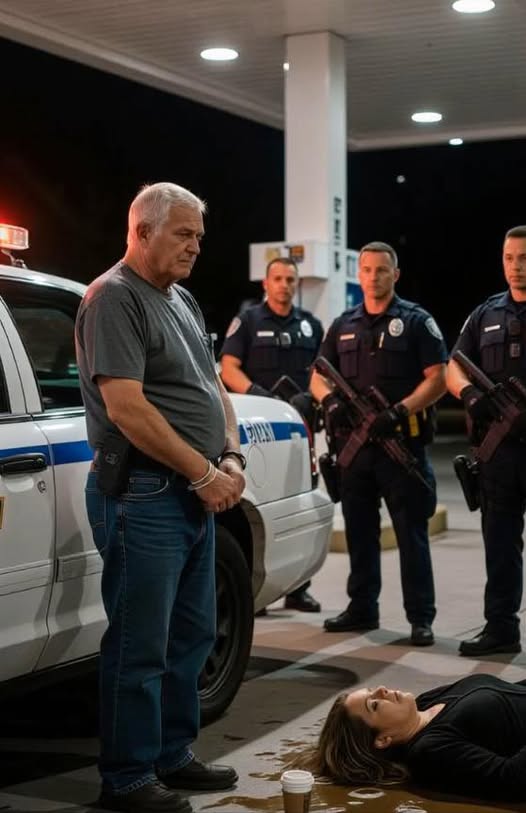
They didn’t just want to kill her—they wanted to erase her. The red dots dancing on her chest weren’t mere warnings; they were promises, silent threats that cut deeper than bullets. Nora Monroe’s breaths came in shallow, jagged pulls, her pulse drumming so violently it seemed to shake the very air around her. Every shadow, every flicker of movement, was a calculation: would this be the moment the world decided she would live—or vanish?
And then it happened. Her husband, Ellis, spoke a single name, and the room convulsed. The hunters became the hunted. Radios crackled to life, chains of command contorted under invisible pressure, and somewhere, in the corridors of power, a man with stars on his shoulders froze, realizing the narrative had flipped. Instantly, authority had shifted. Danger had transformed into leverage, fear into hesitation.
The officers finally lowered their weapons, but the damage wasn’t something that could be holstered. It lingered like smoke in a room no one could open. An invisible crater had ripped through the middle of Nora’s life, shattering any illusion of safety she had ever held. In a heartbeat, she learned a brutal truth: the world’s safeguards, the so-called guardians of order, were fragile, fallible, and indifferent. Ellis already understood. Years of carefully engineering distance between good intentions and fatal consequences had brought him to this exact moment—watching his own wife almost vanish into the cold efficiency of a system that was designed to be fast, confident, and, above all, blind.
He refused to let it remain blind. While the admiral’s voice still echoed faintly through their walls, Ellis began his quiet work. No public displays, no heroic press releases—just meticulous, patient rewiring of the machinery that had nearly taken her from him. New signatures, new checks, new names, and new responsibilities—each a lock in the chain that someone would now have to account for. He fortified the system in the shadows, a guardian unnoticed, preparing a world that had grown too reliant on shortcuts and assumptions.
And when the panic subsided, when the echoes of alarms and gunfire faded into memory, Ellis returned to the small, almost invisible acts of care. The kind that never made reports, never garnered medals, but held lives together in ways no official record could ever capture. He rebuilt safety quietly, one careful bolt at a time, proving that sometimes the greatest heroism isn’t performed on stages—but in the spaces where no one is watching.