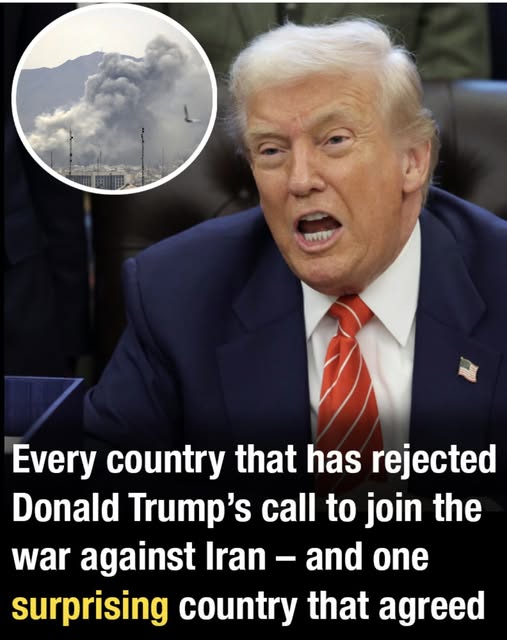
The backlash did not arrive gradually—it struck all at once, sharp and unmistakable. What Donald Trump unveiled as “Operation Epic Fury,” a name meant to project dominance and inevitability, is beginning to look less like a show of strength and more like a solitary wager balanced on the edge of something far more dangerous. The expectation had been clear: that allies would fall into line, that familiar patterns of support would quietly reassemble themselves, that the machinery of Western unity would turn as it always had. But this time, it didn’t.
Instead, the response came in hesitation, in silence, in careful distance. One by one, traditional partners stepped back—not with dramatic refusals, but with the quieter, more telling language of delay, doubt, and conditional support. Europe did not rush forward; it paused, measured, questioned. Across Asia, governments chose caution over commitment, signaling that alignment with Washington was no longer automatic, no longer assumed. Even NATO, long seen as the backbone of collective Western resolve, drew a firmer line than expected, reminding the world that its obligations are not without limits.
Behind the scenes, this slow unraveling of consensus carries a deeper weight. As Trump takes note—who spoke, who stayed silent, who declined—the moment becomes more than a policy dispute. It becomes a ledger of loyalty, a quiet accounting that could shape future decisions in ways not yet visible. And beyond Washington, a broader unease begins to spread. If this is how alliances respond now, under pressure, then what does that say about the next crisis? How far might this go, and who will stand where when it does?
As allies continue to distance themselves from “Operation Epic Fury,” a stark and uncomfortable reality takes shape: the United States may no longer be able to summon immediate, unquestioned support simply by asking. Nations like Britain, Germany, and Italy are signaling a shift that is subtle but profound. Support, they suggest, is no longer synonymous with compliance. It is conditional, calculated, weighed against domestic pressures and the unpredictable consequences of escalation. Their reluctance is not rooted in indifference, but in concern—about widening conflict, about destabilized regions, about the political cost at home if a distant gamble spirals out of control.
And yet, this is not a story of total fracture. There are still threads of cooperation, though they appear in unexpected places. Ukraine’s willingness to assist in countering Iranian drones—even while it remains locked in its own grueling war—speaks to a changing landscape of alliances. Relationships are becoming more fluid, more transactional, shaped less by longstanding loyalties and more by immediate threats and shared interests. It is a world where alignment is negotiated in real time, not inherited from the past.
Still, the tone has shifted. Trump’s remark—“We will remember”—hangs in the air, less a statement than a warning. It suggests that the consequences of this moment will not end with the operation itself, but will ripple outward, influencing future dealings not only with adversaries like Iran, but with allies who chose caution over commitment. In that quiet recalibration lies a deeper tension: the possibility that fractures within alliances may prove just as consequential as conflicts beyond them.
In the absence of a unified coalition, American power feels different—less amplified, more exposed. The margin for error narrows. The cost of miscalculation rises. And as the world watches, what once seemed like a coordinated show of force now carries the weight of isolation, where every move risks echoing louder than intended, and every step forward may be taken alone.