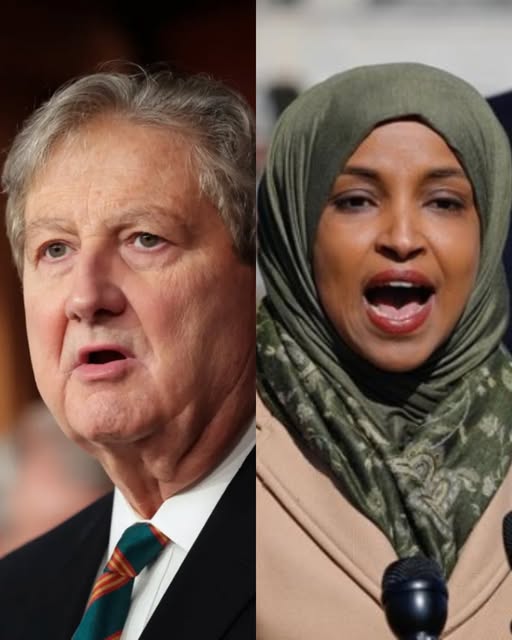
Every camera in the room locked onto him at once, lenses tightening like the barrels of a firing squad. What moments earlier had been a chamber buzzing with rehearsed outrage, whispered coordination, and performative indignation collapsed into silence—so sudden, so complete, it felt physical. The kind of silence that presses against the ears. The kind that warns something irreversible has just begun.
Omar’s words stalled mid-sentence, unfinished and suddenly weightless, as if they had lost permission to exist. Across the aisle, Alexandria Ocasio-Cortez’s confidence flickered—not gone, not broken, but visibly interrupted. Just for a heartbeat. Long enough for everyone watching to feel it. Then Kennedy drew a breath.
It was an ordinary human gesture, unremarkable in any other setting. But in that moment, it shifted everything. In that inhale, the balance of the room tilted—the narrative, the momentum, the moral posture of the hearing itself. It felt as though history had leaned forward in its chair and whispered a single word of warning: Listen.
He didn’t raise his voice. That was the first shock. In a chamber addicted to volume, where outrage is currency and viral clips are the real constituency, Kennedy’s calm landed like an act of defiance. His tone wasn’t sharp; it was measured. Not theatrical, but deliberate. He spoke of duty as something sacred, not something worn for the cameras. Of power as a loan, not a possession. Of public service as stewardship, not branding.
The marble walls seemed to close in, amplifying every syllable. The cameras stopped panning and simply stared. Staffers froze mid-step, mid-text, mid-whisper. Even the air felt heavier, as though the room itself understood the gravity of what was being said and leaned closer to hear.
Omar’s hand slowly lowered from the microphone, the gesture less dramatic than it was telling. Ocasio-Cortez straightened, her expression shifting—not into defiance, but into calculation. Not retreat, but reassessment. The look of someone realizing the battlefield had changed, and that the rules she’d prepared for no longer applied.
Because Kennedy wasn’t attacking them. He wasn’t trading barbs or chasing applause. He was indicting something far larger: a political culture that had turned governance into performance, conviction into content, and responsibility into spectacle. He wasn’t interested in winning the moment. He was exposing it.
And for a brief, fragile stretch of time—so rare it felt almost unreal—no one was campaigning. No one was posturing for the clip. No one was thinking about tomorrow’s headlines. They were simply officeholders again. Custodians of a trust older and heavier than their own names.
The question he left hanging in the silence wasn’t accusatory. It was worse than that. It was honest.
Were they worthy of it?