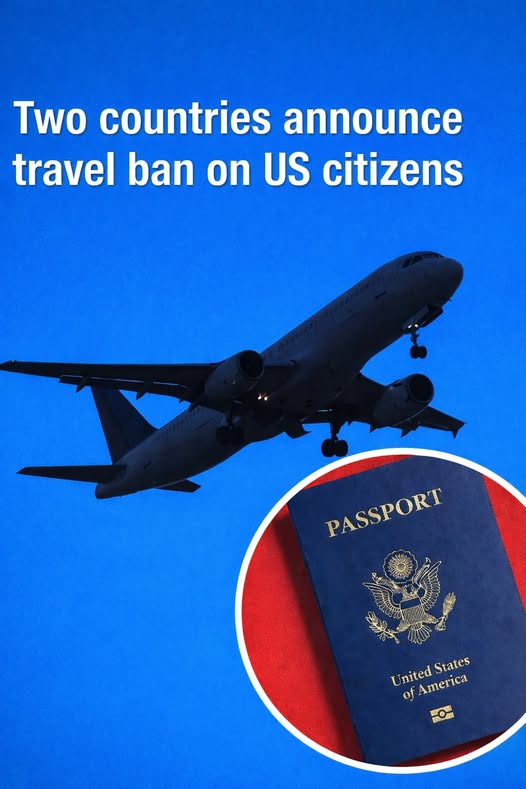
International travel just became a lot more personal—and far more political.
What initially appeared to be a quiet administrative adjustment has unfolded into a pointed diplomatic signal aimed squarely at one of the world’s most powerful passports. In parts of West Africa, the rules are being rewritten, and American travelers are discovering that the ease they once took for granted no longer applies. What began under the tidy banner of “reciprocity” is now exposing deeper tensions over power, respect, and the unspoken hierarchies that govern global mobility.
In Niger, the shift is unmistakable. The country’s decision to halt the issuance of visas to U.S. citizens is not a technical delay or a backlogged system—it is a deliberate statement. By explicitly tying the move to restrictions imposed by Washington on Nigerien officials, the government is making its position clear: mobility should not flow in only one direction. The message is carefully framed. Rather than presenting the policy as retaliation, Niger casts it as a matter of principle, a demand for equal treatment between sovereign states. Yet the impact is immediate and tangible. American travelers who once crossed borders with minimal friction are now stopped by a rule that arrived overnight, reshaping assumptions about access and privilege.
Elsewhere in the region, the response is quieter but just as telling. In Mali and Burkina Faso, there has been no dramatic announcement, no sweeping ban. Instead, the friction shows up in longer processing times, thicker stacks of paperwork, and more probing questions at consulates and checkpoints. The effect is subtle but unmistakable: trust is no longer presumed, and entry is no longer automatic. What used to be a routine stamp has become a negotiation.
For students, researchers, humanitarian workers, and families with ties across borders, these changes carry real consequences. Trips planned months in advance now come with uncertainty. Academic exchanges, aid missions, and personal visits are slowed by a growing sense that movement itself has become conditional. Beneath the procedural details lies a larger truth: visas are no longer just travel documents. They have become instruments of diplomacy, symbols of dignity, and leverage in a global conversation about security, sovereignty, and respect.
Taken together, these shifts mark a quiet but meaningful recalibration of the global travel order. West African governments are signaling that access must be mutual, not assumed, and that even the most powerful passports are not immune to pushback. For American travelers, the experience is a reminder that borders reflect politics as much as geography—and that the freedom to move is increasingly shaped by how nations choose to assert their voice on the world stage.