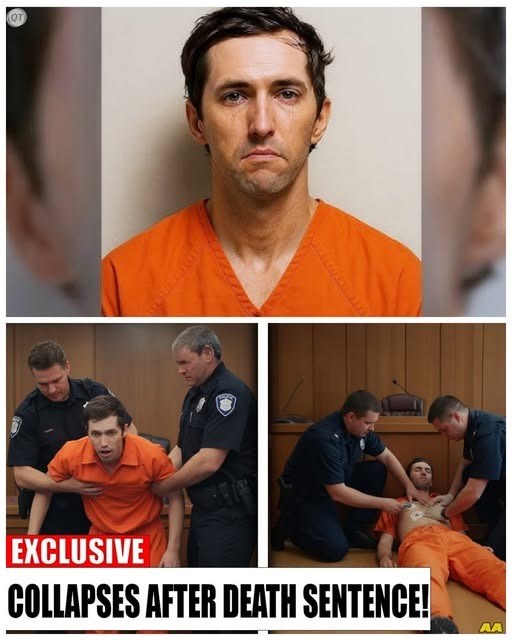
Silence broke him before the law ever did. One moment, he stood upright, rigid, controlled—a figure of composure amid the ritualized solemnity of the courtroom. The next, his body seemed to betray him entirely, folding in on itself as if the polished floor had vanished beneath his feet. There was no outburst, no whispered plea, no desperate word. Only collapse. And in that single, shattering instant, the abstract machinery of justice—so carefully choreographed, so precise in its language—was rendered flesh, visible and unbearably human. The headlines would summarize it in a sentence, clinical and devoid of nuance, but anyone present knew the truth: the law had landed, and a life had bent irreversibly under its weight.
Those who witnessed it will recall less the phrasing of judges or the careful recitation of statutes than the way the room itself seemed to recoil. The gleaming wood panels, the orderly rows, the ritual gestures of gavels and robes—they offered no buffer against the raw, visceral reality of a human being confronting the finality of his fate. The defendant’s fall was not merely physical; it stripped away the distance that law and procedure usually provide, leaving only a person, breathing and trembling, absorbing with full awareness that there would be no return, no second chance, no alternate path forward. What had been a case—a compilation of charges, evidence, and precedent—became, in that moment, entirely a human story of loss, accountability, and finality.
And yet, the system continued on, relentless and unflinching. Papers were signed. Forms were checked. Appeals were filed in anticipation, a procedural rhythm that felt almost cruel in its detachment. Outside the courthouse, the incident was flattened into headlines: neat, digestible, and shockingly devoid of weight. But inside the memories of those who were there, the moment remains jagged and unresolved, a collision between the impersonal authority of law and the undeniable reality of human fragility. It lives in the quick intake of breath, the faint tremor in a hand, the subtle, echoing thud of a body finally understanding the verdict, the sentence, the absolute finality imposed by justice.
Even as the world moves on, as deadlines are met and bureaucracies grind forward, the room holds the echo of that collapse. It reminds those present—and anyone who would try to imagine it—that justice, though lawful, is never merely conceptual. It manifests in the weight of a human life, in the intimate, unrepeatable experience of one person suddenly facing the full force of consequence. It is, in the starkest way, the intersection of law and humanity, where principles meet flesh, and where accountability is no longer theoretical but deeply, painfully real.