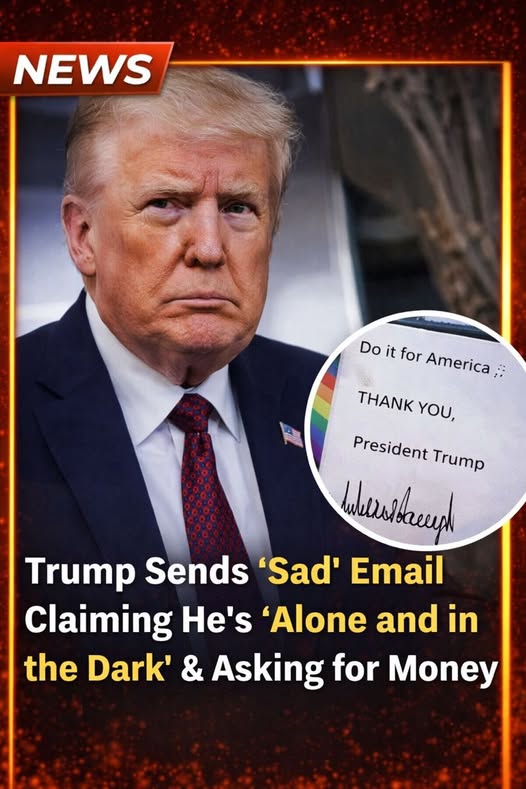
“Alone in the war room,” Donald Trump declared.
Then, almost in the same breath, he asked for money.
The contradiction sat at the heart of a bizarre, almost plaintive fundraising email—one that read less like a campaign appeal and more like a late-night confession. Trump cast himself as isolated, besieged, surrounded by enemies with only a failing laptop and a ticking clock for company. But behind the lonely theatrics lurked something far more unsettling: a White House strategy that framed Europe as weak, decadent, and on the brink of “civilisational erasure,” a continent supposedly in need of a harsh, disciplining warning from Washington.
As Trump rattled sabers over Greenland, Venezuela, and Russia, the email’s melodrama felt carefully staged. A “dying laptop.” A countdown timer. A dire warning that the MAGA movement itself would “crumble” without a $47 donation. The message painted Trump as a man abandoned by allies and betrayed by elites. Yet the performance of loneliness was less a confession than a tool—designed to bind supporters to him emotionally by convincing them that without their loyalty, the nation itself would collapse.
Threaded through the appeal was a familiar arsenal of fears: a “woke mind virus,” “brainwashed” children, borders flung open forever. Personal allegiance to Trump was recast as patriotic duty. To doubt him was to endanger America. It was emotional blackmail dressed up as national salvation, turning anxiety into currency and devotion into obligation.
At the same time, the administration’s rhetoric toward Europe hardened noticeably. Allies were branded “weak,” accused of drifting toward irrelevance and moral decay. Undersecretary Jacob Helberg insisted this was not an insult but a necessary shock—a wake-up call meant to jolt Europe into deregulation, strategic obedience, and distance from rival powers. Trump himself escalated pressure on Denmark over Greenland, invoking “national security” as justification for demands once dismissed as outlandish.
All of this unfolded against a backdrop of widening conflict: U.S. strikes in Venezuela, a grinding and unresolved war in Ukraine, and rising global instability. In that context, Trump’s lonely fundraising email reads less like a cry for help and more like a signal flare. It was not the sound of retreat, but of escalation—an announcement that his battles, both domestic and international, were converging.
The loneliness, it turns out, was part of the strategy. A performance meant to mobilize fear, demand loyalty, and prepare the ground for a more aggressive posture abroad. What looked like desperation was, in fact, a warning: the pressure was rising, the lines were hardening, and Trump was making clear that the fight—at home and on the world stage—was only beginning.