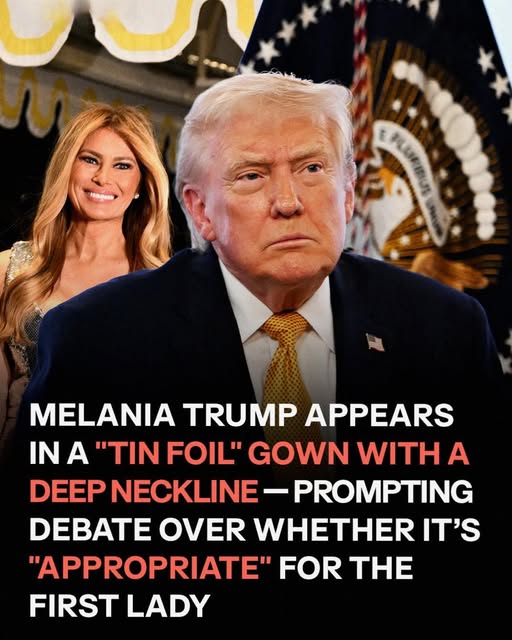
Melania Trump didn’t enter Mar-a-Lago so much as detonate it.
There was no podium. No prepared remarks. No attempt to command attention with words. Instead, she crossed the threshold wrapped in a blinding silver gown—and in an instant, the room rearranged itself around her. Conversations stalled. Heads turned. Phones came out. Within minutes, fireworks cracked outside, power brokers clustered beneath crystal chandeliers, and even Donald Trump’s own message to the crowd faded into background static. The night had acquired its defining image.
Online, the reaction was immediate and combustible. Timelines filled with screenshots, zoom-ins, slow-motion rewinds. Every gleam of sequin was analyzed like evidence in a cultural trial. Praise collided with mockery. Awe battled suspicion. Was it dazzling confidence or calculated provocation? Glamour or defiance? The dress became the story—and then the argument.
What unfolded at Mar-a-Lago felt less like a celebration and more like a meticulously lit stage set for spectacle. Melania’s sculpted silver gown, sharp and reflective, turned her into a living mirror, catching and throwing light in every direction. She was no longer simply present; she was the visual center of gravity. The internet split cleanly down the middle. Admirers applauded her unapologetic embrace of glamour, calling it bold, modern, and perfectly suited to a New Year’s Eve steeped in excess. Critics scoffed, likening the look to aluminum foil or nightclub wear, offended by what they saw as a rejection of the restrained, pastel-toned image traditionally expected of First Ladies.
But that tension—between expectation and autonomy—is precisely what gave the moment its charge.
Inside the ballroom, the evening unfolded with all the hallmarks of high-stakes power theater. Political allies and wealthy donors mingled beneath chandeliers heavy with symbolism and crystal. A live painting of Jesus was auctioned off for a staggering $2.75 million, a surreal blend of devotion, wealth, and performance. Donald Trump’s wish for “peace on earth” hovered above the crowd, echoing softly in a room built on influence, ambition, and transaction.
Yet when the night ended, it wasn’t the speeches, the deals, or even the multimillion-dollar artwork that lingered.
It was the image.
One woman in a silver gown, standing at the intersection of fashion, politics, and provocation—reflecting back a country still deeply divided over power, image, and who gets to decide what is “appropriate” when the spotlight hits.