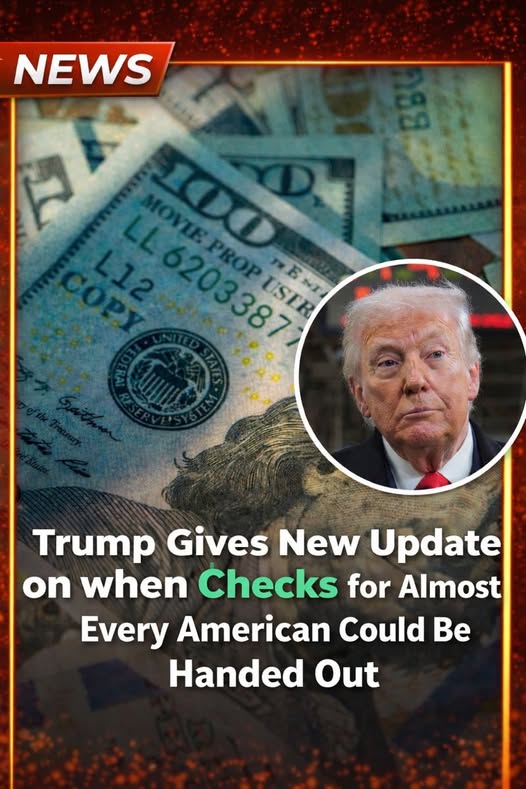
The promise was dazzling in its simplicity — and irresistible in its timing. Every American would get $2,000 checks, paid for entirely by tariffs on foreign imports. It was a pledge designed to sound self-sustaining, patriotic, and painless. But as the months drag on, the numbers don’t add up, and the timeline keeps slipping further out of reach. Now, Donald Trump has quietly moved the goalposts again — and even his latest comments suggest that the much-touted “tariff-funded” bonuses may exist more in political imagination than fiscal reality.
In a recent off-the-cuff exchange, Trump shifted his deadline from “the middle of next year” to “toward the end of the year,” punctuating it with a casual “Did I do that?” — a remark that underscored how fluid and improvisational this promise has become. What was once a banner of economic populism now reads like a moving target, reshaped each time the math or the markets push back. The money, he insists, will come from “substantial tariff revenue,” a claim delivered with his characteristic confidence — but one that economists say defies both logic and arithmetic. Tariffs are not free money from foreign governments; they are taxes paid by American importers, and ultimately, by American consumers in the form of higher prices.
Outside the roar of rally halls and the echo of televised interviews, the fiscal picture looks far grimmer. Independent budget analysts estimate that mailing out $2,000 checks to every adult American could cost around $600 billion — a staggering figure that dwarfs the actual revenue from tariffs collected in recent years. According to Treasury data, even at their peak, tariffs brought in less than a quarter of that amount annually. The gap between promise and possibility is not just wide; it’s yawning.
Economists across the political spectrum are sounding alarms. They warn that the plan would balloon the national deficit — already climbing past historic highs — and pile more weight onto a debt load nearing levels unseen since World War II. For them, the math is unforgiving: every dollar that flows out as a political giveaway is a dollar that won’t go toward shoring up Medicare, Social Security, or infrastructure. As one fiscal watchdog bluntly put it, “Tariffs don’t create money; they rearrange it — from shoppers’ wallets to the government’s pocket.”
The White House maintains that the checks would act as both stimulus and symbolism, proof that “America First” economics can deliver direct rewards. But behind the applause lines lies a more complicated reality: tariffs have raised costs for manufacturers, squeezed supply chains, and driven up consumer prices on everything from electronics to groceries. To many economists, Trump’s “tariff checks” amount to a circular transaction — taking from Americans with one hand and handing it back with the other, minus the inefficiencies of bureaucracy and inflation.
Yet for millions of struggling families, the promise still resonates. In a landscape of stagnant wages, rising rents, and post-pandemic fatigue, $2,000 can sound like salvation. The allure isn’t just financial; it’s emotional — a tangible sign that someone in power is willing to bypass the gridlock and “give something back.” But as deadlines drift and details blur, that feeling is increasingly colliding with skepticism.
In the end, the question is no longer when the checks will arrive, but whether they ever can. Trump’s supporters see a bold act of economic nationalism. His critics see a political mirage — a promise designed to stir hope in hard times, financed by math that doesn’t hold up beyond the rally stage. Between those two visions lies a familiar American divide: faith versus fact, charisma versus calculation, and a growing sense that, once again, the bill for political theater may end up in the taxpayers’ hands.