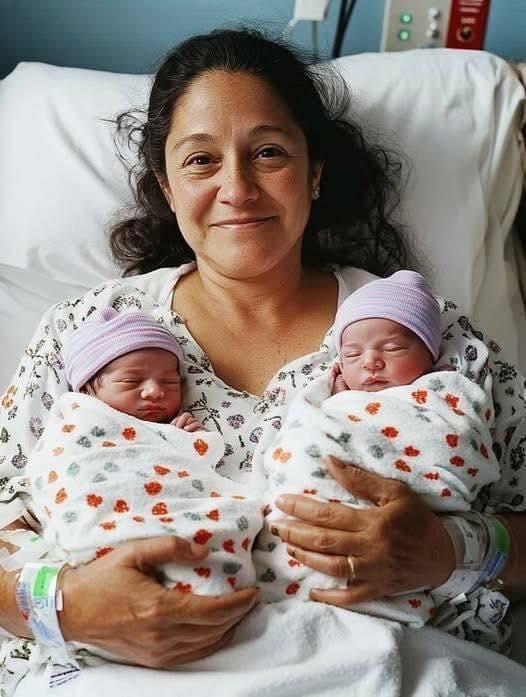
When a 58-year-old woman gave birth to twins, the world was stunned—not only by her age but by the breathtaking miracle of life that defied all expectations. The news spread quickly, capturing hearts everywhere and reigniting the timeless fascination people hold for twins. There’s something almost magical about them—two little souls sharing the same beginning, growing side by side, finishing each other’s sentences before they can even speak.
The idea of twins has always intrigued families and scientists alike. Parents often wonder: What makes twins happen? Is it luck, science, or something written in the stars? While genetics and chance play the largest roles, several factors—ranging from family history to lifestyle—can subtly increase the odds.
The Power of Family Ties
One of the strongest predictors of twin births lies in family history, particularly on the mother’s side. Women who inherit a tendency to release more than one egg during ovulation have a higher likelihood of conceiving fraternal twins. In many families, you’ll find generations where twins seem to “run in the bloodline,” adding to the wonder of inherited fertility traits.
Age: A Surprising Advantage
Age, too, can tip the scales. Women between 35 and 39 years old are statistically more likely to release multiple eggs during ovulation. While pregnancies at this age require careful monitoring due to health risks, nature offers a fascinating trade-off—the biological boost in fertility hormones can sometimes result in the conception of twins.
The Role of Diet and Lifestyle
It may surprise many, but what you eat could influence your chances of having twins. Some studies suggest that diets rich in dairy and protein, particularly those containing natural hormones, may stimulate multiple ovulations. Women with a slightly higher body mass index (BMI) also show increased odds, possibly because higher fat reserves affect estrogen levels.
Even more intriguing, conceiving while breastfeeding has been associated with higher rates of multiple pregnancies. The hormonal changes that occur during lactation can occasionally cause the ovaries to release more than one egg—a curious, natural coincidence that has led to more than a few “surprise twins” in families around the world.
Medical Science and Modern Possibilities
Of course, medicine has transformed what was once left entirely to chance. Fertility treatments such as in vitro fertilization (IVF) and ovulation-stimulating medications significantly raise the likelihood of multiple births. In IVF, doctors often implant more than one embryo to improve the odds of success, which can result in twins—or even triplets.
Additionally, supplements like folic acid—already vital for preventing birth defects—have been loosely linked to an increased likelihood of twin conception. While the scientific community continues to study this connection, it adds yet another layer to the mysterious recipe of twin pregnancy.
The Miracle and the Responsibility
However, as enchanting as twins may seem, a multiple pregnancy comes with its own challenges. Carrying two babies demands more from the mother’s body—more nutrition, more rest, and more frequent medical care. Doctors closely monitor such pregnancies to ensure both babies grow safely and that the mother remains healthy.
Still, for couples who dream of hearing two cries instead of one, small lifestyle adjustments—like eating well, maintaining a healthy weight, and taking prenatal vitamins—can help “stack the odds.” But at the heart of every pregnancy, whether it brings one baby or two, lies the same hope: a safe delivery and a healthy, happy family.
In the end, the 58-year-old mother’s story isn’t just about defying age or statistics—it’s about the profound wonder of life itself. Her twins symbolize more than just a medical marvel; they’re a reminder that miracles can happen at any age, in any circumstance, and that nature still holds a few beautiful secrets waiting to be discovered.