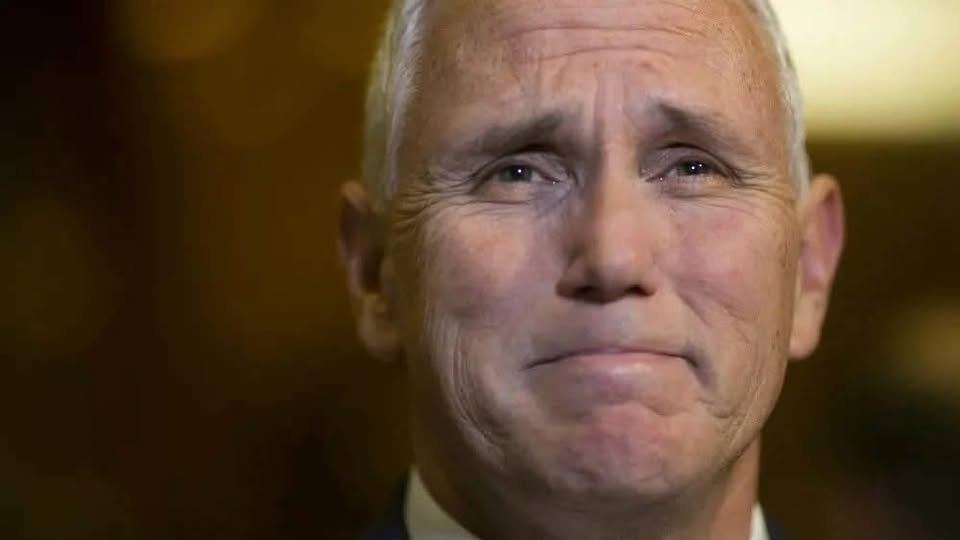
For months, former Vice President Mike Pence had been wrestling with a truth he could no longer outrun—an unrelenting, painful reality that shadowed him through sleepless nights and silent mornings. The decision weighed heavily on him, growing heavier with every passing day. Those close to him had seen the signs: the quiet moments of reflection, the sudden pauses mid-sentence, the way his faith seemed to anchor him even as the world around him shifted.
And then, at last, came the day he could no longer delay.
As the cameras flickered to life and the room filled with the low hum of reporters preparing for yet another press conference, Pence stepped to the podium. But this was no ordinary address. His shoulders, usually squared with confidence, appeared burdened; his face, typically composed and serene, was drawn with emotion. He looked out at the sea of faces before him—some expectant, others skeptical—and for a long moment, he said nothing.
When he finally spoke, his voice trembled ever so slightly. “This,” he began, pausing as if to steady his heart, “is not a statement I ever wanted to make.” The silence that followed was deafening. His words carried a weight that no political slogan could disguise, no speechwriter could soften.
Tears glistened in his eyes as he continued, revealing a side of himself the public had rarely seen. Pence, the stoic Midwesterner, the man defined by faith and discipline, now stood bare before the nation—stripped of political armor, driven purely by conviction and pain. “I have prayed on this for many months,” he said, his voice breaking slightly. “But sometimes faith calls us not to comfort, but to courage.”
Those in attendance leaned forward, realizing this was not the rhetoric of a career politician—it was a confession.
Earlier that morning, before the cameras, before the lights, Pence had woken to a still, gray dawn. He dressed with deliberate care, his mind replaying every word he would soon deliver. In the mirror, he practiced one last time, but even his reflection offered no reassurance. He knew the statement he was about to make would ripple far beyond the walls of that press room—it would challenge loyalties, stir debate, and perhaps redefine his legacy.
He had spent hours in prayer and reflection, speaking quietly with his wife, Karen, who had stood by him through decades of political storms. Together, they had always leaned on faith as their compass, but today that compass pointed toward a road no map could chart.
When he finally stepped up to the podium, the weight of expectation was crushing. For years, Pence had been known for his calm restraint, his unwavering composure even in chaos. But now, that control faltered. His eyes scanned the room once more before he exhaled—a long, steady breath that seemed to release months of pent-up emotion.
What came next would not be remembered for its political implications alone, but for its humanity. It was a moment of raw vulnerability from a man who had spent his life projecting steadiness and certainty. His hands trembled slightly as he gripped the edges of the podium. The truth was out, and with it, the last traces of the old calm he had once worn so easily.
In that instant, politics faded away. What remained was a man—haunted, resolute, and profoundly human—standing before the world with nothing left to hide.