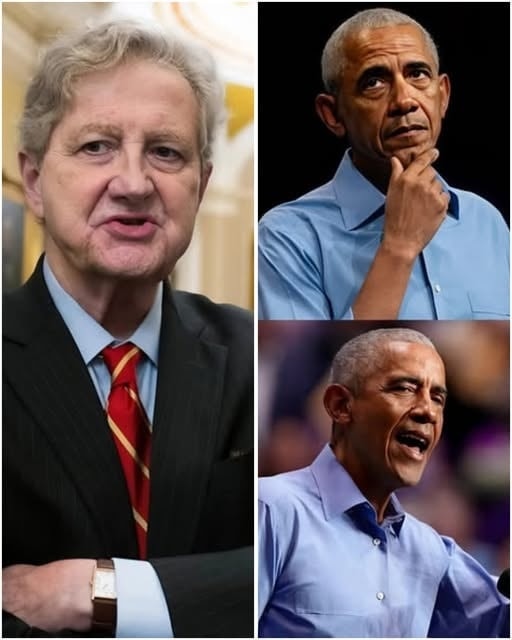
The accusation landed like a political grenade, detonating across cable networks, social feeds, and newsrooms with a force that seemed disproportionate to its source. One senator. One number. One former president. Suddenly, the carefully curated narrative of “public service” was thrown into doubt. Did Barack Obama personally profit from the Affordable Care Act, or was this a ruthless fabrication engineered to provoke outrage, dominate headlines, and fracture public trust? In an instant, timelines melted, pundits ignited, and viewers were drawn into a whirlwind where certainty gave way to suspicion.
What erupted this week was far more than a simple allegation. It was a weaponized story, meticulously constructed to travel at the velocity of anger. Senator John Kennedy’s call for Obama to “return” $120 million lacked the backing of a court ruling, an investigation, or any formal legal authority. Yet it was framed with a tone of sober, procedural concern—as if the senator were reluctantly reminding a fellow citizen of their moral obligation. That was the brilliance of the approach: it disguised a partisan attack as civic housekeeping, making the claim feel legitimate even while casting a former president as a man who allegedly profited from the very reform he championed.
In truth, the drama lies not in the veracity of the claim, but in its circulation. In a media ecosystem addicted to outrage, allegations do not need to be proven to have impact—they only need to be repeated. Each share, retweet, and viral clip hardens suspicion into memory. Fact-checks, carefully worded rebuttals, and investigative reporting may appear, but they arrive after the story has already embedded itself in the public consciousness. Long after evidence is scrutinized and context is clarified, the faint stain of “maybe he did” lingers, shaping not just perceptions of Obama, but perceptions of governance, accountability, and the idea that those entrusted with public service are beyond reproach.
The ripple effects are profound. For supporters, the allegation is infuriating, an attempt to weaponize misinformation against a presidency that reshaped American health care. For critics, it offers confirmation, however tenuous, of the suspicion that political elites benefit personally from the policies they champion. For the nation at large, it is a sobering reminder of how narratives, rather than facts, increasingly drive political reality. Each accusation, amplified across echo chambers and partisan feeds, chips away at trust, reshaping public understanding of history, power, and responsibility.
And yet, beneath the spectacle lies a deeper truth about modern politics: in the age of instant outrage, perception can be more potent than reality. The story of $120 million—true or false—reveals how easily civic accountability can be weaponized, how quickly moral questions can masquerade as evidence, and how the court of public opinion now operates at speeds that no law, fact check, or reasoned argument can hope to match. In this world, accusations are less about justice than memory, less about truth than staying power, and less about debate than the shaping of belief itself.