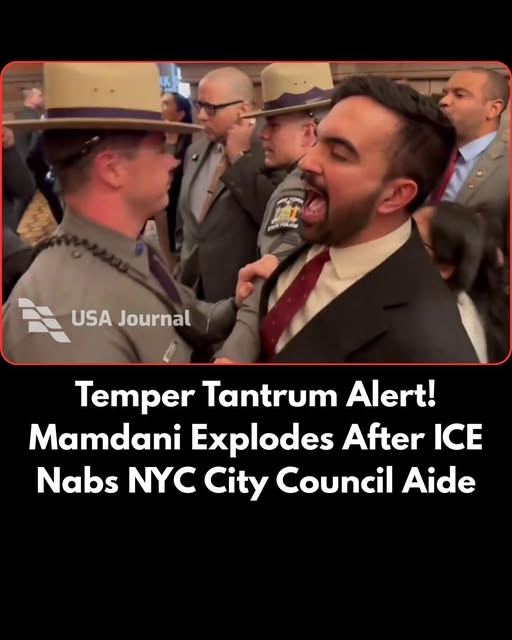
The mask finally slipped — not in rhetoric, but in reality. In New York City, what was meant to be a routine immigration check became a flashpoint in a story that has captivated the nation. A City Council data analyst, here without legal status and with a prior arrest for assault, showed up for an immigration appointment and never walked out. Instead, federal enforcement officers carried him away, igniting a ferocious political firestorm. Across the nation, tensions over immigration have been thrust into the spotlight not as abstract policy debates, but as questions of law, safety, and identity itself.
Mayor Zohran Mamdani erupted in outrage, denouncing the lawful removal as an “assault on our democracy” — framing routine enforcement as political aggression rather than procedural justice. His reaction, intense and visceral, reveals something deeper about the current moment: in the polarized crucible of American politics, even clear‑cut enforcement actions are now cast as existential battles, and every headline becomes a cudgel in a broader culture war.
But the underlying facts are indisputable. The foreign national in question overstayed a visa, never obtained legal authorization to live or work in the country, and yet had been employed within New York City government handling public data. When Immigration and Customs Enforcement (ICE) carried out its legal duty, the mayor’s response treated it less like enforcement of established law and more like a violation of civic trust — a dramatic inversion of roles that mirrors broader debates over law, order, and accountability in cities across the U.S.
This inversion — where those who flout the law are framed as victims and those who enforce it are cast as antagonists — sits at the heart of the current political divide. Critics argue that enforcement agencies like ICE are deploying heavy‑handed tactics with deadly consequences. In Minneapolis, for example, a 37‑year‑old American woman named Renée Nicole Good was fatally shot by an ICE agent during a federal immigration operation, triggering nationwide protests and fierce debate over use of force and agency oversight. Some federal officials defended the shooting as self‑defense, labeling the incident “domestic terrorism,” even as bystander videos and local leaders dispute that narrative and call for transparency and accountability.
Local officials — including Minneapolis Mayor Jacob Frey and Minnesota Governor Tim Walz — have openly criticized federal handling of the investigation, accusing authorities of blocking state participation and contributing to deep mistrust. They argue such episodes erode public confidence in law enforcement and blur the line between lawful duty and unchecked power.
Meanwhile, political leaders on the other side of the spectrum see a system bending over backward to excuse violations of law while attacking those tasked with upholding it. To these critics, describing immigration enforcement as an “assault on democracy” amounts to shifting blame for systemic failures onto enforcement officers who are simply executing existing statutes. They argue that redefining terms like “values” and “justice” to justify inaction or dismissal of clear legal requirements undermines public trust, safety, and common sense.
This is the core of the broader conflict: a battle not just over immigrants’ rights or enforcement tactics, but over the meaning of law and who gets to define it. In some quarters, political leadership has elevated compassion to a virtue that eclipses legal compliance; in others, unwavering adherence to law is seen as moral and necessary. The result is a fractured national conversation in which enforcement actions and political reactions are interpreted through vastly different lenses, each claiming moral high ground.
What remains clear is that these controversies are no longer confined to policy briefings or partisan soundbites. They spill into everyday life — into streets, city councils, courtrooms, and living rooms — shaping how Americans understand justice, safety, and the rule of law. As the debate intensifies, the nation is forced to confront a fundamental question: should the law be applied even when it’s politically uncomfortable, or reinterpreted to fit evolving notions of fairness and community values? The answer to that question will influence not just immigration policy, but the very fabric of American democracy in the years to come.