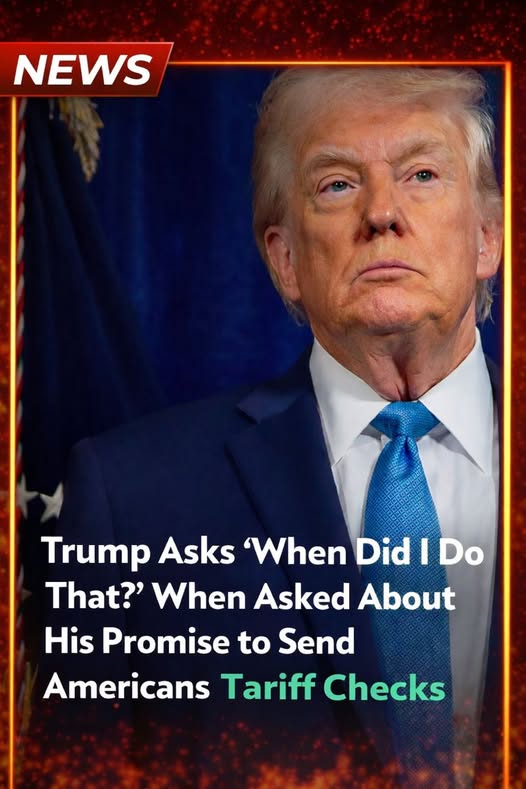
The silence in the Oval Office said everything. Cameras rolled, advisors froze, and for a heartbeat that seemed to last an eternity, the President of the United States appeared to forget one of his own most viral campaign promises — the $2,000 “tariff dividend.”
Pressed by a reporter on the details — when Americans could expect their checks, how the funds would be distributed, and whether Congress had even authorized the payments — Donald Trump hesitated. What followed wasn’t the forceful confidence that has long defined his public persona, but an awkward pivot, a muttered timeline — “toward the end of the year” — and a sudden flurry of aides rushing to clarify what he “really meant.”
That single pause detonated across the political landscape. It was replayed on cable loops, dissected by economists, and memed into oblivion online. In that moment, what had begun as a triumphant declaration — Trump’s claim that Americans would personally benefit from his global tariff war — began to unravel under the weight of its own contradictions.
The “tariff dividend” was originally sold as a bold, populist masterstroke. In a post on Truth Social, Trump had boasted that “FOOLS” opposed tariffs, insisting that foreign nations would shoulder the cost and that the revenue would be funneled back to American families in the form of $2,000 checks. To supporters, it sounded like patriotic economics — a way to make global trade finally work for ordinary citizens. To critics, it sounded like economic fantasy, bordering on fiscal sleight of hand.
Now, months later, the numbers tell a murkier story. Trillions are being claimed in tariff revenue that economists warn may not actually exist in liquid form. Billions are already at risk as trade partners retaliate with their own tariffs, driving up import prices and threatening key American industries. Even the administration’s own Treasury Secretary — once one of the plan’s loudest advocates — has begun to temper expectations, advising citizens to “save rather than spend” any potential windfall to avoid worsening inflation.
But the real test doesn’t rest with economists or even Congress. It lies with the Supreme Court, which is now weighing whether Trump’s sweeping tariff regime violates the International Emergency Economic Powers Act — a law that limits how far presidents can go in imposing trade restrictions without congressional approval.
If the Court rules against the administration, the fallout could be enormous. Instead of sending out $2,000 checks to households, the government could be forced to return hundreds of billions of dollars to the very companies that paid those tariffs in the first place — corporations that have been quietly filing legal challenges since the policy’s inception. The ruling could not only upend Trump’s economic strategy but also puncture one of his most politically potent narratives: that America can grow rich by punishing its rivals.
Behind closed doors, aides now face a daunting balancing act — managing expectations without admitting defeat. Republican lawmakers privately worry that the “tariff dividend” has become a political landmine, while Democrats accuse the administration of selling voters a mirage. The phrase “absolute immunity” may dominate courtroom debates, but on the campaign trail, it’s the promise of $2,000 checks that could decide hearts and headlines alike.
For millions of Americans quietly counting on those payments — retirees on fixed incomes, families struggling with inflation, workers squeezed by higher prices — this drama isn’t about ideology anymore. It’s about trust. Trust in leaders who make grand promises, in systems meant to deliver fairness, and in the idea that when the government pledges help, it follows through.
Because if the checks never arrive, one question will linger long after the press conferences fade:
Who pays when political promises collapse?