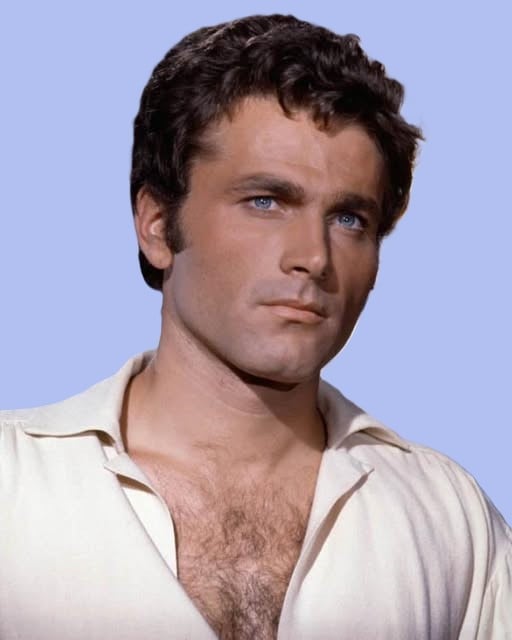
Franco Nero, born Francesco Clemente Giuseppe Sparanero on November 23, 1941, stands as one of the great pillars of Italian and international cinema. More than an actor, he became an emblem of a restless era — a time when European film was redefining itself, daring to explore moral ambiguity, rebellion, and the poetry of silence. With his piercing blue eyes, quiet intensity, and unmistakable sense of control, Nero carved out a presence that could dominate the screen without ever needing to raise his voice.
His ascent to stardom was as swift as it was seismic. In 1966, a young Franco Nero stepped into cinematic immortality with Sergio Corbucci’s Django — the gritty, blood-soaked Western that rewrote the rules of the genre. Draped in a tattered duster coat and dragging a coffin through the mud, Nero’s Django wasn’t a typical gunslinger. He was haunted, wounded, and enigmatic — a man carrying not just a weapon, but the burden of a violent past. With few words but overwhelming presence, Nero redefined the Western hero. The film’s brutal realism, political undertones, and raw emotion struck a chord worldwide, spawning sequels, tributes, and even Quentin Tarantino’s modern reimagining, Django Unchained.
Yet Django was only the beginning. Nero’s career expanded across more than 200 films and television roles, traversing borders, languages, and genres with remarkable ease. From political thrillers that mirrored Italy’s turbulent 1970s, to lavish historical epics and intimate art-house dramas, he proved himself to be a performer of both physical strength and subtle emotion. Whether playing a doomed lover, a revolutionary, or a soldier of fortune, Nero infused every role with a sense of conviction that made even the most improbable scripts feel grounded.
Hollywood soon came calling. Nero appeared in international productions alongside screen legends such as Vanessa Redgrave (who would later become his lifelong partner), Catherine Deneuve, and Laurence Olivier. Despite the language barriers and shifting film cultures, Nero maintained his identity — an actor who brought European gravitas into every frame. His collaborations reflected a man unafraid of reinvention: moving seamlessly from action to romance, from religious epics like The Bible: In the Beginning… to experimental works that tested cinematic boundaries.
What truly sets Franco Nero apart, however, is his unwavering professionalism and artistic integrity. In an industry that often discards its veterans, Nero has remained a symbol of endurance. While cinematic trends evolved — from the raw grit of the Spaghetti Westerns to the glossy spectacle of Hollywood blockbusters — Nero never succumbed to imitation or nostalgia. Instead, he adapted, refined, and endured, always anchored by an authenticity that younger actors continue to emulate.
Even today, well into his eighties, Nero remains active both on screen and behind it, lending his magnetic presence to contemporary projects that honor the past while exploring new cinematic frontiers. His influence ripples through generations of filmmakers who view him not just as a performer, but as a bridge between the mythic past of European cinema and its ever-evolving future.
Franco Nero’s story is not simply that of a movie star — it’s the story of discipline, reinvention, and grace under the relentless gaze of time. His career stands as a testament to the power of restraint and craft in a medium too often driven by excess. Whether trudging through the muddy streets of a ghost town or delivering Shakespearean lines with quiet dignity, Nero has never needed spectacle to command attention. His presence alone — steady, soulful, and timeless — remains his greatest weapon.
In every sense, Franco Nero is not merely a relic of cinema’s golden age. He is its enduring heartbeat — a reminder that true artistry never fades; it simply grows deeper with time.