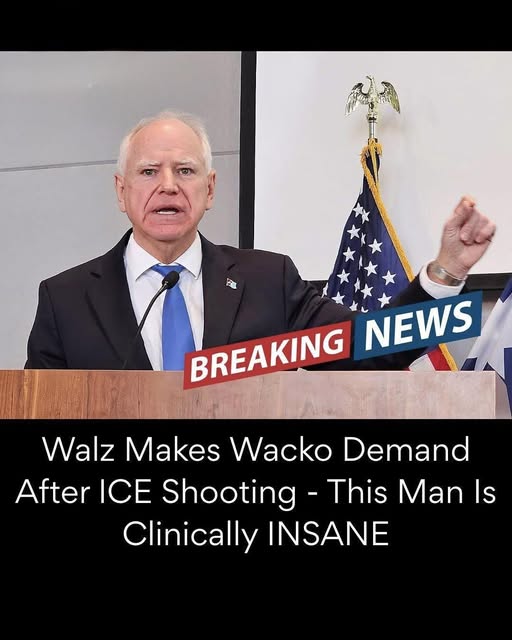
Earlier this week, Minnesota’s governor lit a political fuse that has now detonated into a full-blown crisis. What began as a federal law-enforcement operation on a Minneapolis street has exploded into a confrontation between state and federal authorities, leaving one woman dead, a city on edge, and Gov. Tim Walz scrambling for answers. Cameras are rolling, protests are spreading, and the core questions now stretch far beyond a single tragedy: Who controls justice? Who gets access to the truth? And what happens when political positioning collides with real-world consequences?
At the center of this tempest is the fatal shooting of 37-year-old Renee Nicole Good, a Minneapolis resident and mother of three who was shot and killed by a U.S. Immigration and Customs Enforcement (ICE) agent on January 7 as she sat in her vehicle during a large federal enforcement action.
Walz — a Democrat who built his political brand on resisting harsh federal immigration enforcement and affirming Minnesota as a state that would not cooperate with agencies like ICE — now finds himself squarely in the blast zone he helped create. For years, his rhetoric emphasized distance from federal immigration raids, a stance that resonated with activists and liberal voters. But as the tragedy in Minneapolis unfolded, that stance meant Minnesota had limited formal partnerships with the very federal authorities now conducting the investigation.
Now, with public trust fraying, Walz is demanding transparency and involvement from federal agents — the same partners his policies kept at arm’s length. In a series of tense public statements, the governor has pressured federal authorities to include Minnesota investigators in the probe and insisted that Minnesotans deserve a fair, credible, and transparent inquiry.
But the federal response has underscored the limits of his leverage. The FBI has taken exclusive control of the investigation, blocking state law enforcement from accessing critical evidence like video footage and witness interviews. That move has intensified accusations that the Biden administration’s Department of Homeland Security, backed by the Trump White House, is prioritizing its own narrative over accountability.
At the same time, federal leaders — including Vice President J.D. Vance and DHS Secretary Kristi Noem — have defended the ICE agent’s actions, characterizing Good’s vehicle as a weaponized threat and portraying the shooting as a tragic act of self-defense in the midst of a dangerous operation. Local and national leaders fiercely dispute that characterization, citing bystander videos, eyewitness accounts and statements from public officials who say the evidence does not support the federal narrative.
This clash has laid bare a broader credibility gap: the governor who once turned anti-ICE posturing into a political identity is now demanding the very cooperation he once rejected, all while MnDOT officials — including the county attorney and state attorney general — have begun their own efforts to collect evidence and pursue justice as tensions rise.
The human toll deepens the political stakes. Good’s wife, Becca, has recounted the moments leading up to the shooting and remembered her partner as a peaceful, joyful community member — a stark contrast to federal officials’ portrayal of the incident. Mourners have held vigils; protests have erupted not only in Minneapolis but also in other U.S. cities, while lawmakers from both sides of the aisle call for clarity and accountability.
As state leaders continue to push for access and answers, Walz’s position reflects a difficult reality: a governor who once campaigned on symbolic resistance is now forced to navigate its real and deadly consequences. The very policies and postures that energized parts of his base are now colliding head-on with the raw demand for justice, transparency, and effective governance in a moment of crisis.
And while federal authorities maintain that standard investigative protocols must be followed, Minnesotans — and the nation — are left asking the most painful questions: Who decides the facts? Who gets to tell the story? And how many lives must be upended before those answers come into focus?