The bullet that ended Renee Nicole Good’s life did more than silence her voice — it lit a firestorm that now stretches from Minneapolis to Washington and beyond. In the icy chill of a January morning, as federal immigration agents descended into a south Minneapolis neighborhood, the world watched a single moment explode into a fierce and unresolved national reckoning. In that flash of violence, one woman became both a tragedy and a symbol, and the country was forced to confront a question far bigger than the crime scene itself: What kind of America are we becoming?
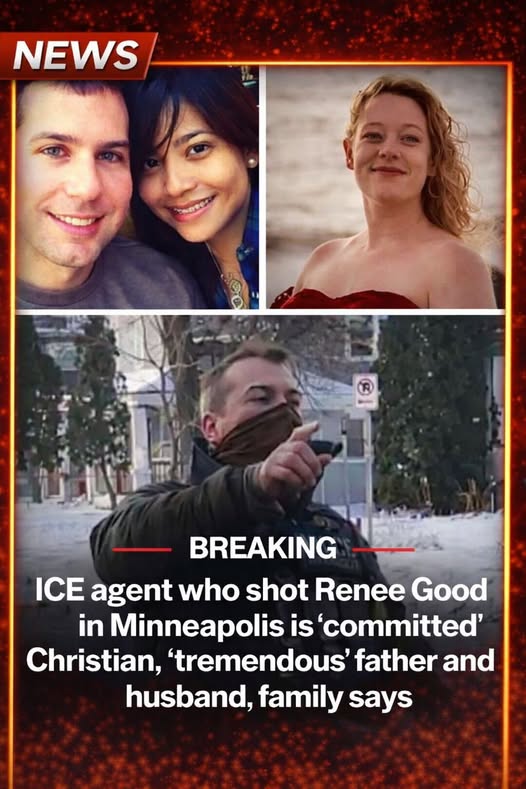
Renee — 37, a mother of three, a poet, a U.S. citizen who had moved to Minneapolis with her family and who loved her community — was shot and killed by a U.S. Immigration and Customs Enforcement officer during an ongoing federal operation. What happened in those seconds now sits at the center of a bitter dispute, with competing narratives shaping how Americans interpret her death and what it means for the future of law enforcement and civil liberties.
The agent who fired, identified through court records as Jonathan Ross, is a seasoned ICE officer and Iraq War veteran with nearly two decades in military and federal service. Federal officials have defended his actions as a split-second judgment made in fear for his life, insisting that Renee’s vehicle posed a threat during the encounter. They have backed his decision to shoot as within his training and necessary under what they describe as dangerous circumstances. The White House, Vice President, and Homeland Security leadership have all echoed a narrative of self-defense and peril.
But from the very start, that account has been fiercely contested. Before independent investigators were even granted access to body-camera footage and forensic evidence, footage and witness testimony emerged suggesting that Renee’s SUV was turning away from agents when the fatal shots were fired — challenging the claim that she was advancing on the officer with hostile intent. Video released online shows her speaking calmly moments before the shooting and then slowly pulling forward, not lunging at anyone.
Her wife, Becca Good, has become one of the most powerful voices in the response to her death. In a heartfelt public statement, Becca described Renee as radiant, compassionate, and anchored in love — someone who carried whistles on her person that day, while federal agents carried guns. “We had whistles. They had guns,” she said, encapsulating the enormous asymmetry of force that now frames the public’s understanding of what happened.
Across Minneapolis and throughout the nation, protests have surged. Crowds have marched, thousands have demanded transparency and accountability, and local leaders have openly criticized federal agencies for excluding state investigators from the probe. The FBI has taken over the case, cutting off Minnesota’s Bureau of Criminal Apprehension from access to evidence — a move that itself has provoked outrage and accusations of a cover-up.
For supporters of the federal response, Ross is a trained veteran and veteran law-enforcement officer who reacted under pressure in a volatile situation. For his critics, the killing is an arresting portrait of what happens when heavily armed agents operate in civilian neighborhoods with little oversight and even less accountability. In this view, Renee’s death is more than an isolated tragedy — it’s a snapshot of a nation grappling with the limits of force, the rights of everyday citizens, and the trustworthiness of institutions sworn to protect them.
Some see self-defense; others see murder. Some see necessity; others see state brutality. Somewhere between those clashing absolutes lies a woman who went about her morning, returned home to her children, and now, in death, has forced an entire country to confront its deepest fears and fiercest divides.