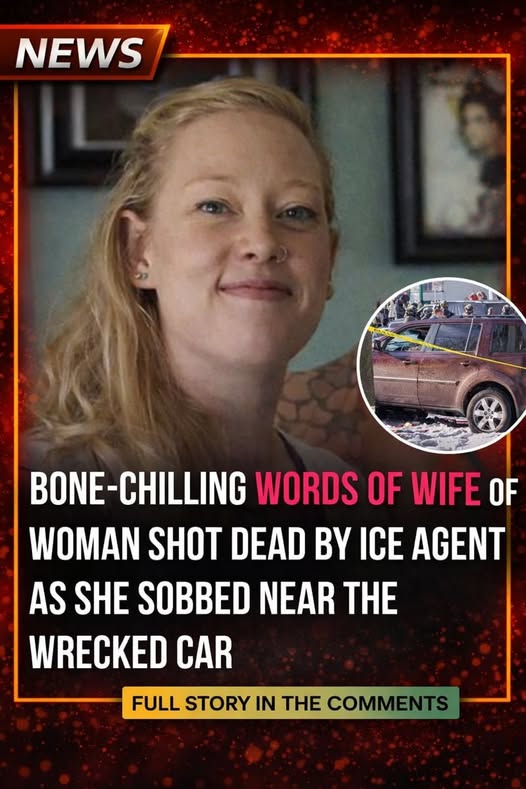
Minneapolis woke up to horror. A poet. A mother. A neighbor who baked cookies for the block and wrote verses that captured quiet moments of life. Renee Nicole Good lay dead in the street, her body slumped over the steering wheel of a shattered SUV. She was 37. She was killed by a federal ICE agent, and the video of her final moments — shaky, horrifying, unrelenting — has already seared itself into the nation’s consciousness.
Officials immediately framed the shooting as self-defense. Witnesses called it murder. The sounds of the morning still lingered in the memory of the city: the metallic echo of gunfire, the screech of tires, the whimpers and then the screams of her wife — raw, ragged, a collision of grief and guilt that cut through the freezing Minnesota air.
In the days since, Minneapolis has become a battleground, a city split between two irreconcilable narratives. Federal authorities insist that an ICE officer fired to protect lives, portraying Renee as a domestic terror threat who “weaponized” her car. They claim she left them no choice. But the footage tells a different story: her vehicle riddled with bullets, her body still, while agents walked away unharmed. City leaders, their faces etched with anger and disbelief, accused Washington of “governing by reality TV,” refusing to accept a narrative that seems engineered for optics rather than truth.
Behind every statement, every tweet, and every political spin is quiet devastation — a neighborhood and family left in tatters. Renee was more than the headlines. She was a poet and a musician, a mother of three who filled her home with warmth, tea, and cookies. Friends remember her laughing over small triumphs and comforting them in heartbreak. Her own mother described her as “loving, forgiving, and affectionate,” a woman whose generosity seemed endless. And now, a six-year-old child faces a world without his mother, while relatives struggle to provide the care, attention, and stability she once offered so naturally.
The city mourns her in small, tangible ways: vigils crowded with candles, icy sidewalks lined with flowers, strangers leaving poems and notes pleading, “Do not let her life be forgotten.” The grief is personal, visceral, and insistent. And yet it collides with politics, ideology, and the brutal machinery of federal power, leaving Minneapolis — and a nation — asking the same unanswerable question: whose story matters more, the person who died, or the version that fits the politics of the moment?
Renee Nicole Good’s life should not be reduced to a contested headline. She was a mother, a creator, a friend, a neighbor — and a single name now etched into a city’s collective sorrow. Across ice-streaked streets and darkened windows, one demand rises above the noise of spin and outrage: her life, and her humanity, must not be erased.