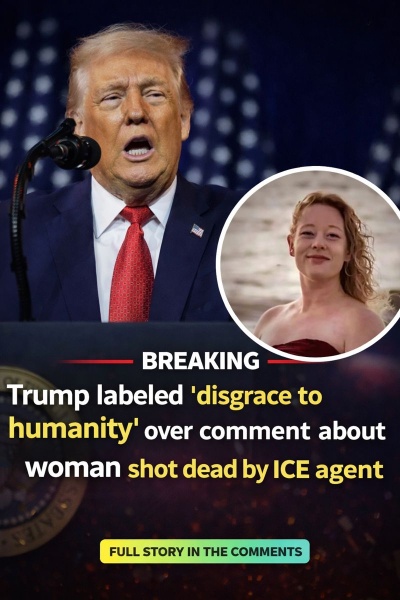
Renee Nicole Good is dead — and the country is coming apart at the seams trying to decide who killed her. In Minneapolis, city leaders are calling it murder. In Washington, the president is defending the man who pulled the trigger. The footage — grainy, trembling, impossible to unsee — has already scorched its way across social media, turning a moment of horror into a national reckoning. A woman’s final scream, a flash of movement, a shot — and silence. Within seconds, another name joined the endless list of the dead, and another American city braced for the storm.
Renee’s final moments play like a nightmare on loop. The cellphone video, captured by a bystander on a frozen Minneapolis morning, shows her trying to drive away — fear written across her face. An ICE officer yanks open the car door. Another steps forward, weapon drawn. Then comes the crack of a single bullet that stops both the car and her heartbeat. The vehicle lurches forward, colliding with a parked SUV as onlookers scream. For her family, time ended right there — one senseless second that turned a mother, daughter, and advocate into a national symbol.
Mayor Jacob Frey, his voice trembling in a press conference that night, refused to hide behind bureaucracy or spin. “This was not self-defense,” he said flatly. “This was an execution.” His words ignited outrage and solidarity in equal measure. Protesters flooded the streets with signs bearing Renee’s name. Others chanted for justice, their voices rising above the wail of sirens and the glow of riot shields. “Get the f*** out,” Frey told ICE. “You are not welcome in this city. You are quite literally killing people.”
But while Minneapolis mourned, Washington moved to bury the truth under politics. Within hours, Donald Trump took to Truth Social, reshaping the tragedy into propaganda. He called Renee a “professional agitator” and “violent threat,” hailing the ICE officer as a hero under attack from the “Radical Left.” His post spread faster than the video itself — a digital wildfire of anger, denial, and division. Homeland Security followed suit, labeling the shooting “domestic terrorism” and insisting it was a justified defensive act.
Across the country, America split in two. On one side, grief turned to fury — another life stolen by a system built to protect itself. On the other, cries of “law and order” drowned out empathy, framing her death as collateral damage in the endless war on fear.
Renee Nicole Good’s death is no longer just a tragedy. It’s a mirror — one showing a nation unable to agree on what justice looks like, or whose life deserves it. And as her family buries her under a sky filled with cameras and questions, one brutal truth lingers like smoke in the winter air: when a woman dies in the street at the hands of the state, who gets to decide what her death means — the people, or the power that killed her?