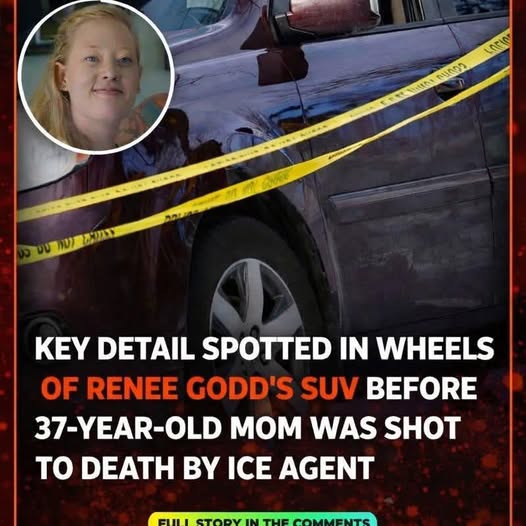
The footage begins like any other shaky cellphone video — unfocused, grainy, and chaotic. But within seconds, it captures the moment Minneapolis can’t stop replaying. From a nearby vantage point, the clip appears to show Renee Nicole Good’s silver SUV inching forward, brushing past an ICE officer who steps back in surprise. Then, almost immediately, the sound of gunfire fills the air — sharp, mechanical, merciless.
Bullets tear through her open driver’s-side window. The SUV jerks forward, tires spinning against the ice before veering down the street. A few heartbeats later, it slams into a parked white sedan about a hundred feet away. The airbags bloom, the engine hisses, and for a moment, the only sound is the wind — and the distant cry of someone screaming her name.
By the time the smoke cleared, Renee lay motionless, and the street was crawling with law enforcement. Within an hour, the narrative began to take shape — fast, coordinated, and defensive.
Federal officials wasted no time backing the agent who fired.
Tricia McLaughlin, assistant secretary for public affairs at the Department of Homeland Security, stood before cameras that same night and issued a statement that instantly ignited outrage. She claimed that Good had “weaponized her vehicle, attempting to run over our law enforcement officers in an attempt to kill them,” describing the incident as “an act of domestic terrorism.”
The words hit like a second gunshot — framing a dead poet and mother of three as a national threat before her body was even cold.
But then came the video.
Circulating online within hours, it painted a different picture — one that contradicted the official language of “self-defense” and “terrorism.” In the footage, the officer appears uninjured. There is no visible moment of life-threatening impact, no visible aggression beyond confusion and fear. Instead, viewers see a woman in a panic, her window shattered, her car riddled with holes — a scene that raises more questions than it answers.
By morning, outrage had spread like wildfire. Activists called it execution, not enforcement. Local leaders accused federal agencies of distorting the truth to protect their own. Minneapolis officials demanded transparency, insisting the public had a right to see the full, unedited version of the encounter.
The government’s version of events — polished, rehearsed, and delivered with bureaucratic certainty — began to crumble under the weight of what millions had already seen with their own eyes.
For the family of Renee Nicole Good, no press release could undo what happened on that frozen street.
For the city of Minneapolis, the question now isn’t just who pulled the trigger — but how long officials can keep calling this justice.