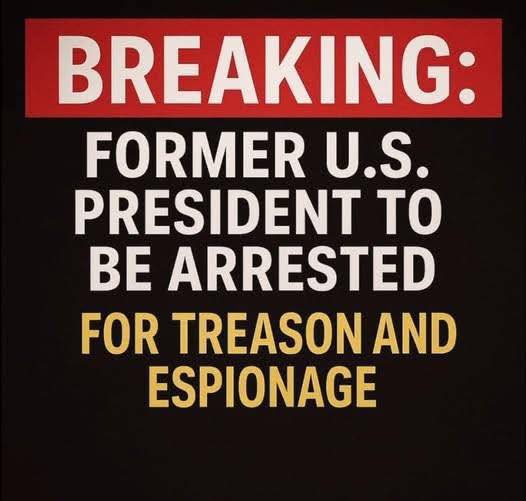
The rumor spread like wildfire, leaping from private message threads to social media feeds in minutes. Barack Obama, the 44th President of the United States, was allegedly on the brink of arrest for treason. Whispers of espionage, secret memos, and covert plots against the sitting administration ignited a political firestorm before anyone could verify a single claim. In coffee shops, online forums, and dinner tables, the question buzzed like a live wire: Could it be true? And if so, what does it mean for the country?
Yet behind the sensational headlines lies a far more insidious reality. Stories like this do not simply appear out of nowhere. They are engineered — meticulously, strategically, and often with the goal of destabilizing trust itself. For years, claims that Obama faced indictment for treason or espionage have circulated in isolated corners of the internet, whispered in partisan chat rooms, and repeated in viral posts. But outside of these echo chambers, there is no evidence. No grand jury filings. No Department of Justice press release. No verifiable insider documents. Only anonymous “sources,” shadowy leaks, and memes crafted to inflame fear, outrage, and uncertainty.
The timing of these claims is never accidental. They emerge when political tension is high, when partisanship runs hot, when trust in institutions teeters on the edge. Each rumor, no matter how baseless, acts like a spark thrown onto a dry forest floor: sudden, blinding, and capable of engulfing reason in flames. Social media amplifies the effect, turning speculation into pseudo-news, and pseudo-news into perceived reality.
The danger is not merely that the allegations are false. It is the erosion they cause — the corrosion of public faith in democratic institutions, in the rule of law, and in neighbors who hold different beliefs. When millions are persuaded to believe that political opponents are not just wrong but traitors deserving prison, disagreement is no longer a civic exercise; it becomes a moral battle. Families, workplaces, and communities fracture as suspicion takes root. Public discourse decays, replaced by fear and the constant question: Who can we trust?
In moments like this, the real courage is subtle. It is the willingness to pause, to scrutinize the source, to distinguish between fact and fiction before forwarding another rumor or clicking “share.” It is the decision to refuse the manufactured chaos a foothold in one’s own mind. It is, in essence, the act of defending democracy not with anger or conspiracy, but with patience, verification, and reasoned judgment.
Because the stakes are nothing less than the trust that binds a nation together. When citizens start seeing treason under every headline, espionage in every email, and betrayal behind every political gesture, the very foundations of democracy begin to crack. And in that void, rumors do not simply survive — they thrive.
The story of Obama’s alleged arrest may vanish tomorrow, or it may linger in whispered threads and viral posts, but the lesson remains: chaos can be manufactured, fear can be weaponized, and the greatest act of patriotism in an age of misinformation may be to slow down, check the facts, and hold on to a commitment to truth — even when the world screams otherwise.