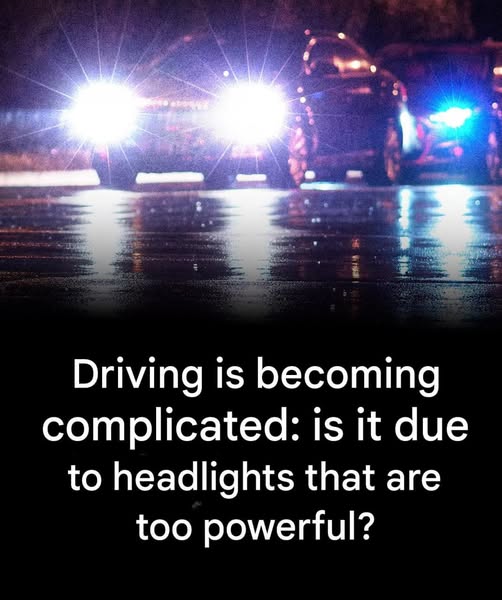
The glare hits you before you even know what’s happening.
One moment the road is yours — dark, quiet, stretching ahead in twin ribbons of asphalt. The next, a searing white light floods your windshield, and everything disappears. The painted lines vanish. The edges of the lane blur. Your hands tighten on the steering wheel as instinct takes over — slow down, blink, recover, hope you’re still centered on the road.
It lasts only a second, maybe two. But that second can feel endless.
Millions of drivers experience that same jolt every night — a flash of blindness followed by a surge of unease. And the question always comes: Is it me? Are my eyes getting weaker? Or have car headlights simply become too bright?
The answer, like the glare itself, is complicated — and it’s hiding in plain sight.
Over the past decade, the evolution of headlight technology has quietly transformed the nighttime roadscape. Gone are the soft, amber halogen bulbs that once cast a gentle glow. In their place, sleek, high-intensity LEDs and laser systems now slice through darkness with surgical precision. Their beams are whiter, sharper, and far more focused — designed to stretch visibility hundreds of feet ahead.
On paper, this is progress: safer illumination, better reaction times, fewer nighttime collisions. But for the human eye — especially one fatigued after hours of screen exposure or late-night driving — this progress comes with a price. The harsh blue-white spectrum of modern headlights is closer to daylight than the warmer tones of older bulbs. Our pupils constrict suddenly, struggling to adjust, while the surrounding darkness seems even deeper by contrast.
It’s not just about brightness — it’s about physics, perception, and design. The color temperature of light changes how our eyes respond, and the direction of the beam determines how intrusive it feels. A properly angled headlight directs most of its energy toward the road; a poorly adjusted one shoots straight into the eyes of oncoming drivers.
And here’s the rub: even a few millimeters of misalignment can make the difference between visibility and visual assault. SUVs and trucks, with their higher stance, naturally cast beams at the eye level of drivers in sedans and compacts. Combine that with LED intensity, rain-slicked roads reflecting light upward, and the effect multiplies — a dazzling, disorienting glare that makes night driving feel more dangerous than it should.
Researchers have a name for it: disability glare — the temporary loss of contrast sensitivity caused by intense light scattering across the retina. It’s not just discomfort; it’s measurable impairment. For a second or two, your brain literally loses track of what’s in front of you. Pedestrians vanish. Road signs blur. Reaction time doubles.
Yet for all the frustration, this isn’t an inevitability of modern life — it’s a fixable problem.
Start small. Have your headlights checked for proper alignment — most shops can do it in minutes. If you drive a heavier vehicle or frequently load the trunk, use your manual beam adjuster; even a slight tilt downward can reduce glare for others while improving your own vision. Keep your windshield spotless, inside and out — interior film buildup can amplify glare dramatically.
And when those blinding lights approach, train your eyes just a few degrees to the right, toward the white edge line of your lane. It’s a small trick used by professional drivers to preserve night vision without losing awareness.
Meanwhile, automakers are quietly racing toward a solution. Adaptive beam technology — already common in parts of Europe — uses cameras and sensors to automatically shape the light pattern around oncoming cars, brightening what you need to see and dimming what others don’t. It’s the kind of innovation that could make night driving feel natural again — bright where it should be, gentle where it must.
Until then, the glow of progress comes with a price we all share: a world made clearer by technology, but sometimes harder on the eyes. And as you steady your grip and the glare fades, one truth remains — the road ahead may be bright, but it’s up to us to make sure it’s safe to see.