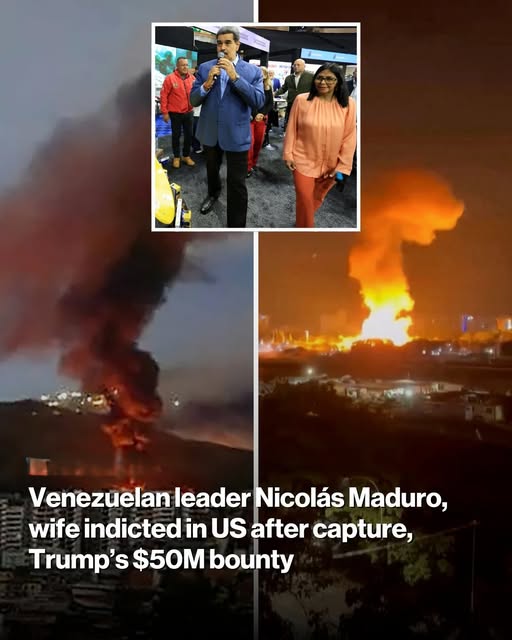
The night sky over Caracas erupted in fire.
Explosions rippled across the city like thunder rolling through concrete, echoing down the narrow streets of barrios and bouncing off the steel of half-finished towers. Windows shattered, alarms wailed, and above the chaos, the air itself seemed to tremble. When the smoke began to clear, the impossible had already happened: Nicolás Maduro — Venezuela’s unshakable strongman, the man who had ruled through hunger, fear, and defiance — was gone.
Dragged from power in a covert U.S. raid, Maduro vanished into the dark as American aircraft streaked low over the capital. What began as rumors on social media — whispers of helicopters and gunfire — soon exploded into confirmation: the United States had taken him. In Washington, officials called it justice served. In Caracas, it was kidnapping. Across Europe, diplomats pleaded for restraint, warning that history rarely ends neatly when empires claim to be liberators.
For Venezuela, the night felt like the shattering of something more than a regime — it was the collapse of a world long held together by fear, oil, and propaganda.
Within hours, images began to surface: smoke rising from military compounds, blackouts spreading through neighborhoods, soldiers stripping off uniforms and melting into the crowds. A government that once projected invincibility had evaporated in the span of a single night. Power lines crackled, cell towers failed, and over the radio came the sound of panic — mixed with disbelief and the occasional cheer.
In Washington, the tone was triumphant. Donald Trump, beaming from behind a podium at Mar-a-Lago, hailed the mission as “a brilliant success,” insisting that “justice has finally come to Venezuela.” He described the operation as swift and bloodless — words that rang hollow against footage of burning fuel depots and civilians fleeing into the streets. “No Americans lost,” he emphasized. “No more tyranny.”
The official charges against Maduro are sweeping: narco-terrorism, cocaine trafficking, weapons smuggling, money laundering — an entire empire of crime, wrapped in the veneer of government. U.S. prosecutors claim he built a shadow economy that linked the presidential palace to drug cartels stretching from Caracas to Mexico City. For years, Washington branded him a kingpin disguised as a head of state. Now, they say, he will face what he denied millions of his citizens — a real trial. A real verdict.
In Venezuela, though, the vacuum is instant and perilous. Vice President Delcy Rodríguez appeared on state television demanding proof of life, denouncing the raid as “foreign aggression.” The broadcast cut out mid-sentence. Within minutes, the streets filled with speculation — had she fled? Was she next? Loyalists called it a coup. Opponents called it liberation. And in whispered corners, another name began to rise — María Corina Machado — a voice of opposition long silenced, now suddenly seen as the possible bridge to something new.
But even hope here is fragile. Electricity flickers on and off. Supermarkets remain half-empty. Soldiers patrol without orders. For every Venezuelan cheering in the streets, another watches from a window, afraid that the fall of a tyrant might unleash something worse — chaos, retaliation, or civil war.
Abroad, the world stands split. In Europe, leaders urge calm and accountability. In Latin America, governments watch nervously, wondering if Washington’s reach has crossed a line that cannot be uncrossed. “The end of one dictatorship,” a Brazilian diplomat warned, “does not guarantee the birth of democracy.”
In the space of a few violent hours, Venezuela’s fate has been rewritten. A man once thought untouchable now sits somewhere in U.S. custody, awaiting a courtroom that may define more than his future. It may define America’s too.
And as dawn breaks over Caracas, the fires still burn. Mothers hold their children close. Radios crackle with rumors. The city exhales — shaken, uncertain — while the hemisphere asks the only question that matters now:
Did the fall of a tyrant just ignite something far worse?