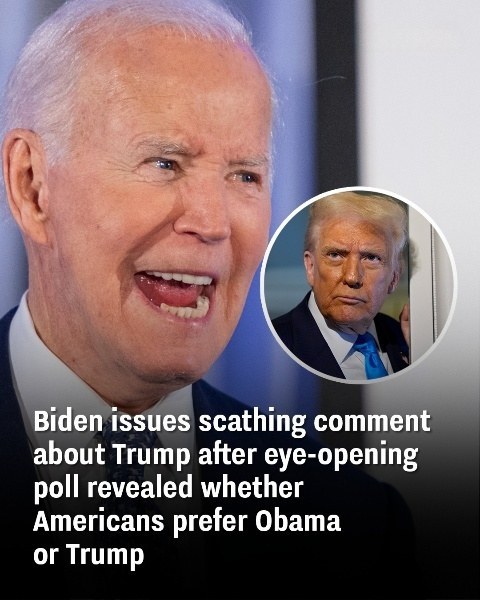
Joe Biden stood up — slowly, deliberately — and something in the air shifted. The room, moments earlier filled with low chatter and the hum of cameras, fell dead silent. For a man long accused of restraint, of softening his blows, what followed was a rare, unfiltered eruption. This wasn’t the polished politician or the avuncular optimist. This was Joe Biden — the survivor — snapping.
He held the papers in his hand like evidence at a trial. A new poll. Brutal. Unforgiving. The numbers didn’t just sting — they humiliated. Barack Obama, his old running mate and political brother, was soaring in post-presidency approval. Donald Trump was sinking fast. And Biden, still marked by the scars of his private war with cancer, looked suddenly like a man who had run out of patience — and out of reasons to hold back.
When he spoke, his voice was low but unwavering. “This isn’t about who wins the next news cycle,” he began. “It’s about what kind of country we’re leaving behind when all this chaos burns itself out.”
Biden’s attack on Trump wasn’t a partisan sound bite. It was a warning — framed not for applause, but for history. He pointed to the poll, yes, but used it as a mirror: a reflection, he said, of a nation exhausted by noise, by grievance, by what he called Trump’s “wrecking-ball politics.” His tone hardened. “You can’t build a future on destruction,” he said. “You can’t call it leadership when the only thing standing at the end is the rubble.”
The imagery was deliberate and cutting — a portrait of a presidency that, in Biden’s telling, shattered more than policy. It shattered trust, civility, and the faith that government could still be something more than theater. He painted Trump not as a leader of a movement but as a vandal of democracy — a man who broke institutions just to hear them crack, leaving ordinary Americans to pick up the pieces while the powerful walked away untouched.
And then, unexpectedly, Biden went personal.
He spoke of his fight with prostate cancer — the scans that made him hold his breath, the radiation that drained his strength, the quiet terror that crept in at night when the White House lights went dark. He described the hands that steadied him — the doctors, the nurses, the people who refused to let him fade. Gratitude flickered through his voice, but so did fury. Because, he said, the care that saved his life is not guaranteed for everyone.
That was the pivot — the moment the political became visceral.
“This is what it’s really about,” he said, looking up. “Who gets to live. Who gets the scan, the treatment, the chance to fight. And who doesn’t — because someone decided healthcare was too expensive, too complicated, too political.”
He accused Trump and his Republican allies of plotting to roll back protections for preexisting conditions, to dismantle the Affordable Care Act piece by piece until survival itself became a privilege again. He warned that healthcare, not polling, would decide the next election — not who smiles better on television, but who can afford the next diagnosis.
By the time he finished, the room was silent again, but for a different reason. What had started as a political broadside had become something closer to testimony — the sound of a man who has faced death and found clarity in the fight that followed.
For once, Joe Biden didn’t sound like a candidate defending a record or a president managing the message. He sounded like a man who had walked through hell, come back scarred, and realized there was no point pretending anymore.
And as the lights dimmed, one thought lingered — unspoken, heavy, undeniable: in a political world built on posturing, Biden had just done something radical. He had told the truth, even if it hurt.