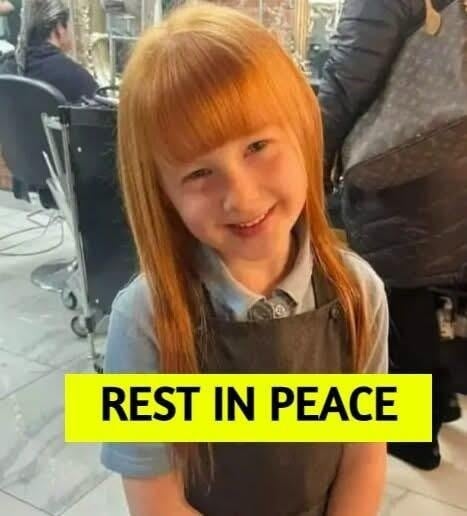
Some children seem to carry sunlight with them — a warmth that brightens even the darkest corners of a room.
Five-year-old Lila Marsland was one of those children. She had a laugh that could make strangers smile, a curiosity that never dimmed, and a heart so big it filled every space she entered. Her parents said she had “a sparkle in her soul,” the kind that made even ordinary days feel special.
Lila had just started school, proudly wearing her tiny uniform and backpack that looked far too big for her small frame. She was still glowing from Christmas morning, when she unwrapped her new bike — bright pink with silver streamers on the handlebars — and spent hours racing up and down the sidewalk, calling for her parents to watch. Life, for the Marsland family, was full of the promise and excitement of a new year.
But within days, that promise would shatter — replaced by grief, disbelief, and unanswered questions.
Lila’s story would no longer be remembered for her laughter, but for the heartbreaking failure that took her life too soon.
A Walk That Changed Everything
It was December 27, 2023, a gray but peaceful day near Dovestone Reservoir in Greater Manchester. Lila and her family decided to go for a walk — a simple family outing, wrapped in scarves and laughter, eager to enjoy the crisp winter air before the holidays ended.
About halfway through, Lila complained of a headache. Her parents assumed it was fatigue or the chill in the air. But on the way back to the car, things took a sudden turn — Lila began to vomit.
Back home, her parents watched anxiously as their daughter’s energy faded. The once-bubbly five-year-old grew quiet and pale. By evening, she was lethargic, drifting in and out of sleep, and soon developed stiffness in her neck — a symptom that sent a jolt of fear through her mother’s heart.
A Mother’s Instinct
Lila’s mother, Rachael Mincherton, was no stranger to illness. She wasn’t just any parent — she was a district nurse at Tameside General Hospital, the same hospital she rushed Lila to that night. Years of medical training told her something was deeply wrong.
“It didn’t feel like a virus,” she later said. “It felt like something much worse. My gut told me it could be meningitis.”
Her instincts were right — but no one listened.
A Warning Ignored
At the hospital, Rachael’s fear was met with calm dismissal. Doctors suggested it was likely a mild infection, perhaps a stomach bug, and that Lila simply needed rest and fluids. Despite Rachael’s urgent pleas and her insistence that the symptoms matched meningitis, her concerns were brushed aside.
“She’s just tired, Mum,” one clinician reportedly told her. “We’ll monitor her for a bit.”
But Rachael knew the difference between tired and unwell — and what she saw in her daughter’s eyes terrified her.
As the hours passed, Lila’s condition deteriorated rapidly. By the time doctors recognized the severity of her illness, it was too late. The infection had already advanced beyond the point of intervention.
A Preventable Tragedy
Lila passed away not long after — leaving her parents shattered, her community in mourning, and the hospital under scrutiny for what has been described as a tragic and preventable medical failure.
“She trusted them,” Rachael said quietly, her voice breaking. “I trusted them. And they didn’t listen.”
In the days that followed, tributes poured in from across the region. Teachers at her school remembered her as “a burst of sunshine,” friends drew pictures of her smiling on her bike, and neighbors lit candles outside the Marsland home.
But behind the grief lies a deeper anger — one that fuels Rachael’s determination to make sure no other parent experiences what she did. “If they had just listened,” she said, “my little girl would still be here.”
Lila’s story has since sparked renewed calls for better pediatric training, faster diagnostic responses, and stronger protocols for meningitis symptoms — especially when raised by medical professionals themselves.
Her mother’s fight is no longer just for answers. It’s for change.
Because Lila Marsland’s life, though heartbreakingly short, deserves to mean something — not as a cautionary tale, but as a reason for hospitals everywhere to listen, to act, and to never again mistake a mother’s instinct for panic.
Her glow may no longer light up rooms, but her story continues to illuminate a truth too long ignored.