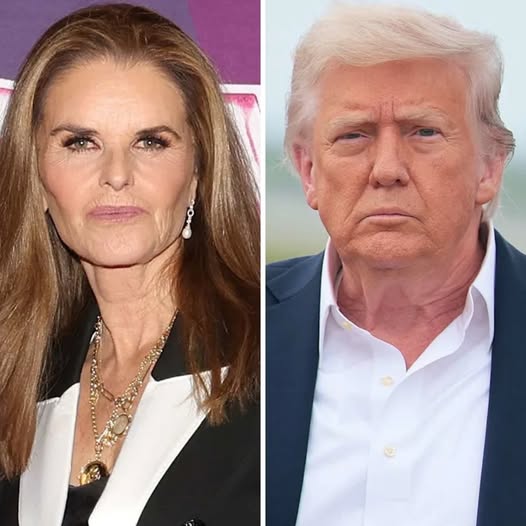
Maria Shriver Didn’t Hold Back: Inside the Kennedy Family’s Fury Over the “Trump-Kennedy Center” Plan
Maria Shriver didn’t mince words.
The moment the “Trump-Kennedy Center” proposal leaked, fury rippled through one of America’s most storied families like a shockwave. What began as a whisper about “rebranding” the John F. Kennedy Center for the Performing Arts erupted into open outrage — a collision of legacy, ego, and history playing out in full public view.
For the Kennedys, the center is not just another Washington landmark. It is sacred ground — a marble and glass monument to their family’s highest ideals, built to embody John F. Kennedy’s belief that art, intellect, and imagination were essential to democracy itself. It was meant to outlast politics. To inspire. To remind America of what it could be at its best.
Now, that legacy is under threat.
According to the leaked documents, the proposal would rename the complex the “Trump-Kennedy Center for the Performing Arts,” citing a “major philanthropic restructuring” designed to secure new funding and modernize operations. But beneath the bureaucratic language, the symbolism hit like a gut punch: the merging of two names that stand for entirely different visions of America.
Maria Shriver’s response captured the mood of her family — and much of the public. In an impassioned statement, she described the proposal not as an honor but as “a rewriting of history dressed up as generosity.” Her tone was raw, personal, and unmistakably Kennedy: both idealistic and indignant. “This isn’t about money,” she said. “It’s about meaning — about preserving a promise that was never meant to be sold or shared.”
Inside the Kennedy compound in Hyannis Port, the reaction was immediate. Family members, advisers, and longtime allies of the arts center traded calls late into the night. The consensus was clear: this wasn’t just a naming dispute — it was a moral line in the sand. To place Trump’s name before JFK’s, they argued, would turn a living memorial into a billboard for power and vanity.
Behind the scenes, the politics are murkier. Trump, who now chairs the board overseeing the Kennedy Center, reportedly appointed many of its current members. Sources close to the board say the vote to consider the renaming was pushed through under the guise of “financial necessity,” but insiders describe a very different motive: Trump’s long-standing desire to see his name etched alongside — or above — America’s most revered.
“The irony,” one former board member said privately, “is that the Kennedys built a center for the arts. Trump built one for attention.”
That tension — between legacy and ego, preservation and power — now defines the fight. Critics see the renaming push as part of a broader trend: the politicization of American memory. Monuments, libraries, and museums are no longer just cultural spaces; they’re battlegrounds for identity, where the past can be rewritten with the stroke of a pen and the promise of a donation.
To the Kennedys, however, this one feels deeply personal. The idea that Trump’s brand — bold, divisive, transactional — could be fused with the legacy of a president who spoke of sacrifice, unity, and public service is more than offensive. It’s existential.
“John believed the arts elevate us,” Shriver said in a later interview. “This feels like the opposite — like turning something sacred into spectacle.”
Whether the plan moves forward remains uncertain. But one thing is clear: the battle over the Kennedy Center has become something much larger than a dispute about a nameplate on a building. It’s a struggle over who gets to define American greatness — and whose version of history will stand in marble when the lights dim and the curtain falls.