The room went silent before the storm hit.
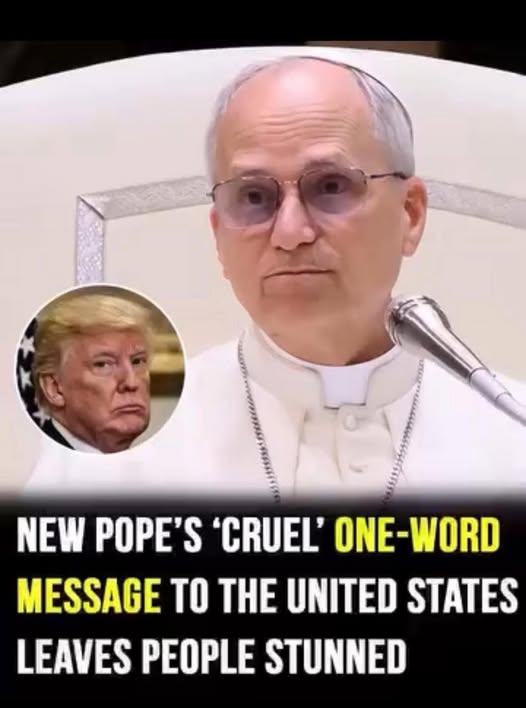
Inside the Vatican’s marble hall, beneath the weight of history and the gaze of saints carved in stone, a single word was spoken — softly, almost prayerfully — yet it rippled outward like thunder.
“Many.”
That was all Pope Leo XIV said.
No sermon. No notes. No carefully prepared statement meant to please or provoke. Just one word — “Many” — uttered with such quiet conviction that it seemed to hold the breath of the world inside it.
At first, the audience wasn’t sure what to make of it. Cameras flashed. Translators hesitated. Reporters looked to one another as if to confirm they’d heard correctly. But within minutes, the meaning — or the mystery — was everywhere. Headline after headline, timeline after timeline: What did Pope Leo mean by “Many”?
It was the most unassuming word imaginable, and yet it landed like a revelation.
For Americans watching from across the Atlantic, already fractured by politics and faith and fear, the Pope’s word felt like both a blessing and a warning. In an age when every public figure seems desperate to speak more, Leo XIV had done the unthinkable — he spoke less, and in doing so, said everything.
Born in Chicago’s South Side, Pope Leo XIV was not the product of European ceremony but of American struggle. His choice of name — evoking Leo XIII, the 19th-century pope who defended workers’ rights and the dignity of the poor — was itself a message. And in that context, his single word, “Many,” sounded less like an accident and more like a mirror — reflecting back the world’s divisions, fears, and unhealed wounds.
It pointed to many wounds, many hopes, many burdens that America still carries and refuses to face. It was about the many who go unseen — migrants waiting at border crossings, families trapped between slogans and systems, laborers surviving paycheck to paycheck while politicians trade talking points. It was about the many who feel abandoned by both heaven and earth.
By saying almost nothing, Pope Leo XIV compelled everyone else to speak.
Progressives heard a rebuke of greed and inequality. Conservatives heard a moral awakening, a reminder that faith is not fashion. The disillusioned heard something rarer still — a leader who refused to be drafted into their endless war.
In a single syllable, the Pope had done what no policy, tweet, or protest could: he reframed the debate. No longer left versus right, believer versus skeptic, patriot versus critic. The line he drew was sharper and more universal — dignity versus indifference.
And perhaps that’s why “Many” hit so deeply. It wasn’t a word for theologians to dissect or for pundits to spin. It was a challenge, a quiet confrontation: How many people have we stopped seeing? How many wrongs have we normalized? How many times have we mistaken noise for truth?
As the cameras clicked and the murmurs swelled, Pope Leo XIV simply smiled — that small, knowing smile that saints in paintings wear when they’ve already said enough. The silence that followed felt sacred, like the moment between thunder and rain.
His message to America has only just begun. But with a single word, he ensured that the country — and perhaps the world — could no longer pretend it hadn’t been spoken to.
Because “Many” was never just a word. It was a mirror — and in it, every nation, every soul, could see itself.