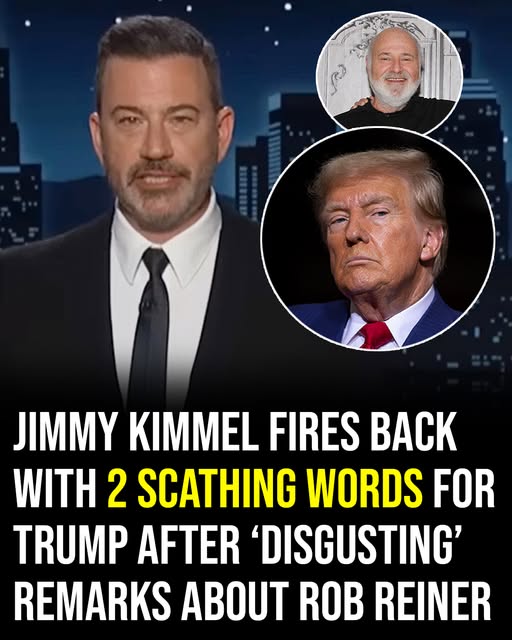
The words were so cruel, so nakedly contemptuous, that Jimmy Kimmel initially assumed they couldn’t possibly be real. They read like parody—too sharp, too callous to have come from the highest office in the country. And then he read them aloud. The laughter never came. What followed instead was a stunned quiet, the kind that settles when humor collides with something irreparably broken.
As Hollywood reeled from the devastating loss of Rob Reiner and his wife, Michele, the nation expected at least a flicker of restraint, perhaps even a gesture of humanity. What it received instead was mockery. In a Truth Social post that spread rapidly across screens and timelines, the president chose derision over decency, framing Reiner’s death not as a tragedy, but as a political morality tale. He invoked “Trump derangement syndrome,” transforming a family’s grief into a punchline and a moment of mourning into ideological theater.
The reaction was swift and visceral. The post landed like a punch to the gut for an industry already in shock. Rather than honoring a revered filmmaker and his partner, the president appeared to weaponize their deaths, casting them as collateral damage in a culture war that refused to pause even for bloodshed. When reporters later offered him a chance to soften his words—to step back from the edge and acknowledge the human cost—he declined. Instead, he doubled down, repeating the language and labeling Reiner as “deranged” and “very bad for our country,” as though political grievance outweighed the sanctity of life itself.
Late-night television, usually a refuge of satire and release, shifted tone dramatically. Jimmy Kimmel, visibly shaken, abandoned easy jokes and spoke with raw anger. He drew a hard line between spirited political disagreement and what he described as “a sick and irresponsible man’s mouth,” arguing that there must be limits—lines that should never be crossed, especially in the face of unimaginable loss. Stephen Colbert followed with a monologue stripped of irony, opening his show in near-eulogy. Tragedy, he insisted, is “sacred ground,” and exploiting it corrodes whatever remains of public decency.
As the commentary unfolded, the story itself grew darker. Reports emerged of a “very loud argument” between Rob Reiner and his son, Nick, at a Christmas party hosted by Conan O’Brien—details that transformed public shock into something closer to dread. The subsequent stabbing deaths of Rob and Michele Reiner, and Nick’s arrest in connection with the killings, shifted the conversation from politics to something far more unbearable: a family destroyed, a private implosion made painfully public.
What began as a debate about rhetoric and responsibility quickly became a collective reckoning. It was no longer just about a president’s words or a comedian’s outrage. It was about how a nation processes grief, how easily empathy is sacrificed for outrage, and how quickly tragedy is consumed by the machinery of politics. In the end, the most disturbing realization wasn’t the cruelty of the post—it was how familiar it felt, and how little room seemed left for mercy.