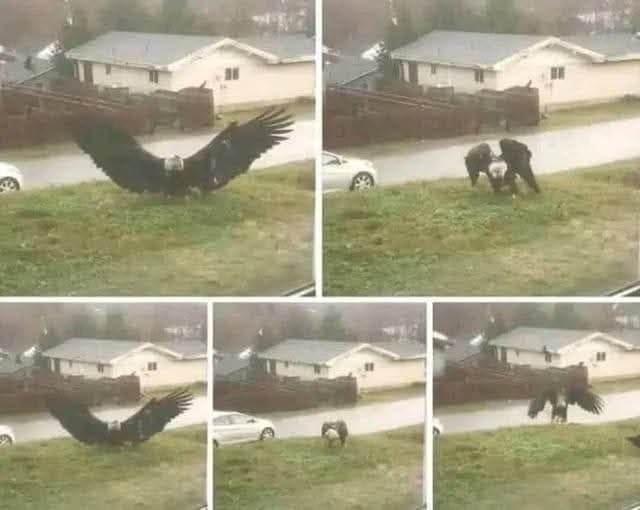
BROWNSVILLE, TEXAS — What began as an ordinary day for a small group of hikers near the U.S.-Mexico border has turned into one of the most astonishing wildlife discoveries in recent memory. A giant eagle—larger than any species ever recorded in North America— has been safely captured near Brownsville, Texas, sending ripples of excitement and disbelief through both the scientific community and the public.
According to initial reports, the enormous raptor boasts a wingspan of nearly 10 feet (over 3 meters)—a size that dwarfs even the largest golden or harpy eagles known to science. Those who first spotted the bird described it as a “living shadow” gliding through the trees, its wings slicing silently through the humid air before it perched on a towering mesquite. “It looked like something out of prehistory,” one hiker said, still awestruck. “When it turned its head and locked eyes with us, you could feel its power.”
The Capture and Conservation Effort
Local authorities, recognizing the rarity of such a sighting, quickly coordinated with wildlife specialists and ornithologists from across the region. After hours of careful observation and tracking, the team successfully captured the eagle using non-invasive methods, ensuring it was not harmed in the process. The massive bird is now under the care of a wildlife rehabilitation and research facility in South Texas, where scientists are conducting thorough examinations to determine its origin, species classification, and health status.
Preliminary observations suggest the bird may not fit any known species category. Its feather patterning, talon size, and bone structure differ from those of other raptors found in the Americas. “We are truly looking at something extraordinary,” said Dr. Elena Vargas, a leading ornithologist involved in the study. “Whether this is a unique genetic mutation, an undiscovered lineage, or a rare visitor from another ecological zone, it challenges what we thought we knew about avian biodiversity.”
Some experts have floated the possibility that the eagle could be a remnant of a once-thought-extinct population, perhaps related to prehistoric species that once dominated the skies during the Pleistocene era. Others believe environmental factors—such as climate change, habitat loss, and shifting migration patterns—may have driven the bird far from its native range, forcing it into contact with human civilization for the first time.
A Global Fascination
Since news of the capture broke, Brownsville has found itself at the center of a media frenzy. Bird enthusiasts, wildlife photographers, and curious onlookers have flooded social media with speculation and fascination. The hashtag #TexasGiantEagle has already trended worldwide, and conservationists are urging restraint and respect for both the bird and the ongoing investigation.
Local officials have also issued statements asking the public not to approach the capture site or attempt to search for additional specimens, citing the need to minimize stress on local wildlife. “We understand the excitement,” said a spokesperson for the Texas Department of Parks and Wildlife, “but our primary goal is to protect both the eagle and the ecosystem it came from. This could be a once-in-a-century discovery.”
A Mystery Still Unfolding
As scientists continue to analyze DNA samples and behavioral data, the mystery deepens. Could this bird be the first of its kind ever documented—or evidence that nature still holds secrets beyond our current understanding? Whatever the answer, one thing is clear: the skies over Texas just became a little more mysterious.
For now, the giant eagle rests under expert care—its wings folded, its presence monumental, and its story only just beginning.