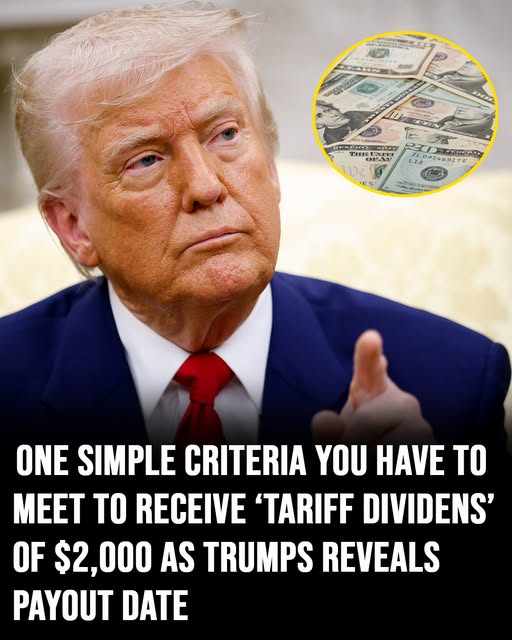
If You Meet This Single Requirement, You Could Qualify for Trump’s $2,000 Tariff Dividend — But There’s a Catch
Donald Trump’s pledge of a $2,000 “tariff dividend” has quickly become one of the most talked-about promises in American politics — a bold idea tailor-made for a nation weary from inflation, soaring costs, and economic fatigue. The message is simple and emotionally charged: if tariffs on foreign goods have filled government coffers with “hundreds of billions of dollars,” then ordinary Americans deserve a share of that money back.
The proposal strikes a populist chord. Families drowning in grocery bills, retirees watching savings shrink, and overworked parents trying to make ends meet see in Trump’s plan something both moral and immediate — a direct reward for putting “America first.” The pitch grows even more enticing with talk of a single qualifying requirement: an income limit of around $75,000 a year. That threshold, Trump hinted, would determine eligibility, making it sound as though millions of low-, moderate-, and middle-income households could soon expect checks in the mail.
To many, the concept feels refreshingly straightforward — as if the machinery of government is already turning, ready to distribute long-overdue relief. But beneath the campaign shine lies a far more complicated and sobering reality.
So far, there is no approved program, no IRS infrastructure, and no legislation supporting the payout. The “tariff dividend” exists only as a promise — not a policy. Despite Trump’s claims of “hundreds of billions” collected, federal tariff revenues total roughly $150 billion, a sum that would barely scratch the surface of what’s needed to deliver $2,000 to every eligible American.
Even within Trump’s own party, skepticism is mounting. Key Republican lawmakers — typically allies on economic issues — are warning that the idea could balloon the national deficit by over $2 trillion, further straining an economy already burdened by record debt. Some conservative economists argue that the plan would fuel more inflation, undoing the very relief it’s meant to provide. Others quietly question whether the “dividend” is a campaign-season illusion — a rhetorical flourish meant to stir headlines rather than bank accounts.
Still, the promise carries power. It speaks to a deep frustration simmering across the country — a belief that ordinary Americans keep paying while global corporations keep winning. Trump’s tariff dividend channels that resentment into something tangible: a check, a number, a sign that someone in Washington is willing to share the spoils.
For now, though, the “single requirement” is symbolic, not real. There’s no form to fill out, no direct deposit on the horizon, and no congressional path in motion. The idea lives in a fragile space between hope and politics, powerful enough to ignite expectations — yet not strong enough to touch a single wallet.
Whether it becomes a genuine policy or fades as another campaign promise will depend on what happens next: the math, the votes, and the political will to turn rhetoric into relief. Until then, the $2,000 “tariff dividend” remains what so many bold promises begin as — an echo of what struggling Americans wish were true.