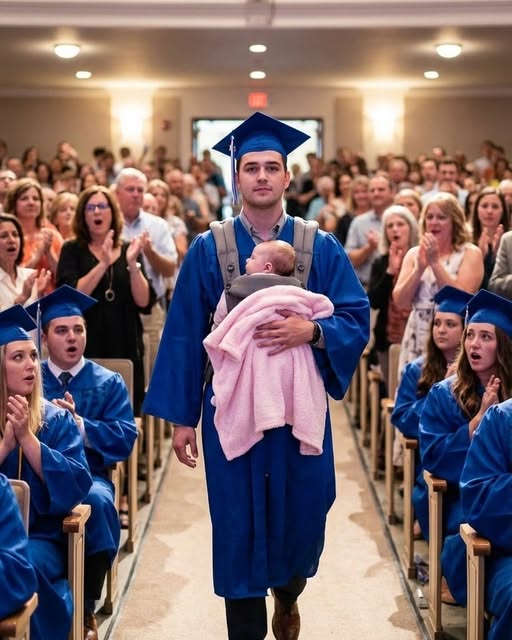
The room changed its temperature the moment he stepped forward with the baby in his arms.
It wasn’t a literal shift, but it felt like one—like the air itself had decided to judge us. Conversations cracked mid-sentence. Laughter sharpened into something thinner, meaner. I could feel it all landing on my skin: the sideways glances, the half-hidden smirks, the kind of silence that isn’t empty but full of verdicts waiting to be spoken aloud.
Somewhere behind me, someone hissed a comment meant to wound, and it did its job too well. I had lived enough years to recognize that particular kind of cruelty—the kind that pretends to be concern, that dresses humiliation up as truth. Every stare in that room felt like a sentence I had already been serving for eighteen years, except now it wasn’t just mine anymore. It had found him. It had found us.
And then my son walked to the microphone.
He didn’t rush. He didn’t shrink. He stood there with the kind of stillness that only comes after surviving too much too young. In his arms, his newborn daughter slept against his chest, small and impossibly unaware of the world arguing over what her existence meant.
For a moment, even the room seemed unsure of itself.
He looked down at her first—really looked, like she was the only thing holding him upright. Then he lifted his gaze to the crowd, not with defiance, not with apology, but with something quieter and far more dangerous to the story they had prepared for him.
And then he spoke five words.
Five words that didn’t just pass through the microphone—they cut through the entire atmosphere of the room, clean and irreversible. I remember the way the sound left him, simple and steady, and how it landed like something none of us were ready to catch. In that instant, I saw faces change. Smirks falter. Certainty fracture.
The breath went out of the audience as if someone had opened a door inside the room and let the truth in.
Because the narrative we had been trapped inside—the one written long before either of us had a chance to argue with it—finally cracked down the middle. The labels that had followed him like shadows his whole life suddenly looked smaller in the face of what he was doing in real time: standing, choosing, staying.
I had worn that narrative like a punishment for years. Careless mother. Broken family. Another statistic folding into another generation. I had learned how to walk under its weight, how to stop flinching when people looked at me like they already knew how our story would end.
But watching my son in that moment, holding his daughter like she was both responsibility and promise, I realized something shifted that no one in that room had permission to name.
He was refusing it.
Refusing the script. Refusing the expectation that he would disappear. Refusing the idea that presence was optional. While others saw a scandal wrapped in a pink blanket, he saw something else entirely: a life that would not be abandoned the way he had once been abandoned in so many quiet, ordinary ways no one ever thought to count.
And in choosing to stay, he rewrote everything.
Later, when the noise dissolved into memory and the room no longer mattered, we returned to the cramped quiet of our apartment. The kind of quiet that doesn’t feel peaceful at first—just honest.
There were no cameras there. No audience. No judgment waiting in the corners. Only the reality that follows every bold decision: midnight feedings that blur time into exhaustion, bills stacked like unanswered questions, and the unglamorous repetition of trying again when trying again is all you have left.
We failed on some days in small, frustrating ways that felt enormous in the moment. We argued on others, words spilling out sharper than intended, regret arriving too late to stop them. But even in the mess of it, there was one thing we didn’t do.
We didn’t walk away.
And slowly, something began to change shape inside that struggle. The cruelty that once defined us started to lose its authority. Even the memory of that woman’s voice—“just like his mother”—stopped sounding like an accusation over time. It became something else. Something we took back.
A banner, not a bruise.
Because if “just like me” means choosing love when leaving would be easier, if it means staying present when absence would be simpler, then maybe the story was never what they said it was.
Maybe my son didn’t repeat the past at all.
Maybe he looked straight at it… and broke it open.