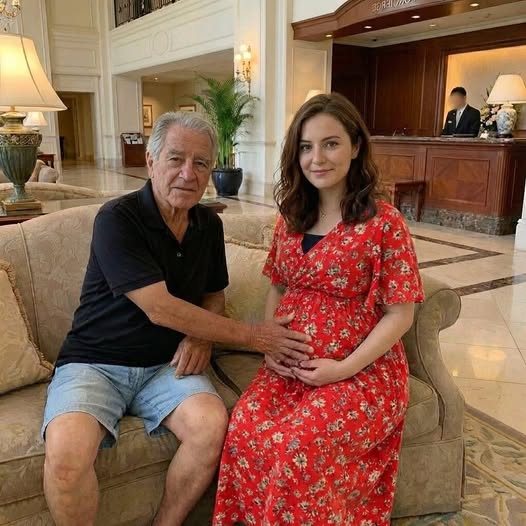
When Yuki announced, almost casually, that she was going to marry a seventy-year-old man she had only just met, the reaction was immediate and merciless.
Friends froze mid-conversation. Relatives laughed in disbelief. Some thought it was a joke that had gone too far, others assumed it was rebellion dressed up as romance, and a few quietly concluded she must be unwell. Whispers followed her like shadows in corridors, online messages turned sharp with concern disguised as judgment. “She’s throwing her life away,” they said. “There must be something wrong.”
And yet, ten days after a small, quiet wedding held by the sea—no grand guests, no spectacle, only the sound of waves folding into the shore—Yuki was standing in a cemetery, staring down at a grave that still felt unreal. The world that had been so loud about her decision suddenly had nothing to say in the face of silence.
What happened in those ten days between “I do” and goodbye would later become something she could never fully explain to anyone who hadn’t been there. And perhaps she stopped trying.
People had demanded answers before the wedding even happened. “Why him?” they pressed. “Why a man seventy years old? What could you possibly share?” They pointed out the obvious differences like they were verdicts: age, habits, the way he wore socks with sandals without a hint of embarrassment, how he kept stacks of old newspapers as if time itself could be archived and revisited.
Yuki herself hadn’t been able to articulate it then. Not in a way that satisfied anyone else. Only much later, when the noise of judgment faded into distance, did she begin to understand what had actually drawn her to Kenji.
He hadn’t been an escape from her life. He had been something far stranger and rarer.
He had been a mirror.
With him, there was no performance required. No subtle competition of achievement, beauty, or status. No need to curate her words or measure her worth against invisible standards she was constantly exhausted by. Around Kenji, those systems simply dissolved. There was only quiet—an almost disarming kind of quiet—and within it, the radical experience of being accepted without condition.
Even at her most uncertain. Even when she was messy, doubtful, or completely unguarded.
He didn’t try to fix her. He didn’t try to elevate her. He simply saw her, as if seeing her was the most natural thing in the world.
And then, just as quickly as it had come into her life, it was gone.
His death after ten days felt, at first, like a kind of cosmic cruelty—an arrangement too brief to mean anything, too intense to survive. People around her called it tragic in the way people do when they don’t know what else to call something they can’t categorize.
But grief, as it often does, refused to stay sharp forever.
Weeks turned into months, and what had once been a blade slowly softened into something quieter. Not less painful, but different. Almost luminous in its persistence.
She began noticing the remnants he left behind in ways she hadn’t been able to at first. The gardening gloves still resting by the door as if he might return any moment. The small handwritten notes tucked into forgotten corners of drawers. The recipes he had carefully written out, smudged with oil and time, as though cooking was less about instruction and more about care preserved on paper.
These things became evidence—not of loss alone, but of presence.
Of how deeply a person can exist in such a short span of time.
It challenged everything she thought she knew about length, about permanence, about what makes a life meaningful. It wasn’t years that defined what she had experienced with Kenji. It was attention. It was honesty. It was the way time felt different when it was shared without pretense.
Yuki didn’t “move on” in the way people expected her to. She moved forward differently. More deliberately. Less concerned with fitting into the shape of a normal story and more committed to honoring the strange, irreversible one she had already lived.
She stopped measuring her life by how it looked from the outside. She stopped chasing the kind of narrative that could be easily explained or comfortably approved.
Instead, she carried forward something quieter—something no one else could see but that had fundamentally changed her: the understanding that being truly seen is rare. Terrifyingly rare. And that sometimes it arrives not in long decades, but in fleeting, extraordinary moments that refuse to be forgotten.
In a world obsessed with longevity, optics, and acceptable choices, Yuki learned something most people never pause long enough to notice:
That depth is not measured in duration.
It is measured in presence.
And sometimes, ten days is enough to change an entire life.