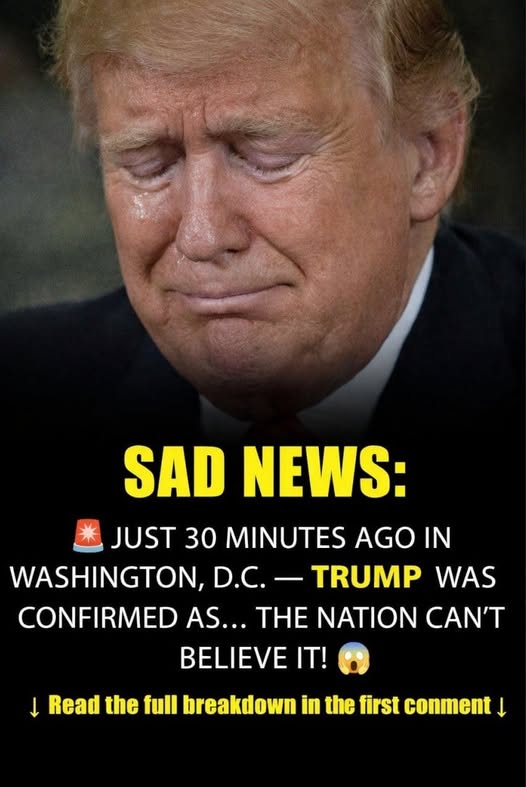
The room seemed to forget how to breathe the instant his voice broke. It wasn’t loud or dramatic—just a subtle fracture, the kind that slips through before anyone has time to brace for it. Yet in that tiny crack, something enormous shifted. A man whom millions believed they understood, whether they admired him or opposed him, suddenly felt unfamiliar. The certainty that once surrounded him flickered. His eyes caught the light differently, no longer reflecting command alone, but something far more fragile. His words stumbled, and in that hesitation, the world leaned closer—not out of loyalty or outrage, but out of instinct. Something real was happening, and everyone could feel it.
What followed didn’t neatly resolve speculation or silence critics. Instead, it unraveled the narrative entirely, pulling at threads people didn’t even realize were loose. The moment refused to fit into headlines or partisan talking points. It stretched beyond them, leaving a country not just shocked, but suspended—caught between interpretation and emotion, between reaction and reflection. People weren’t just watching anymore; they were absorbing, questioning, recalibrating.
When he finally spoke again, the tone had changed. Gone was the familiar rhythm of defiance, the polished cadence of practiced lines. In its place was something heavier, slower, more deliberate. The words carried a weight that no campaign slogan, no courtroom exchange, no rally chant had ever quite held. He didn’t dominate the moment—he yielded to it. And in doing so, he revealed something unexpected. This wasn’t a performance aimed at winning approval or controlling the narrative. It felt, at least for a fleeting moment, like something closer to truth.
He didn’t confess in any formal or legal sense. There was no admission designed for headlines or consequences. But there was something undeniably human in what emerged—an acknowledgment of strain, of pressure, of the quiet erosion that comes from being turned into a symbol larger than oneself. He spoke, not as a figure carved into certainty, but as someone confronting the cost of that transformation. The exhaustion wasn’t abstract. The fear wasn’t hypothetical. It lingered in the pauses between his sentences, in the way his voice struggled to steady itself.
For a brief, almost surreal stretch of time, the usual machinery of politics seemed to stall. The rehearsed divisions, the predictable outrage cycles, the constant spin—all of it felt distant, like noise from another room. This moment didn’t belong to strategy. It wasn’t about dominance or defeat. It was about something far less controllable: the possibility of breaking under the weight of expectation, of being seen not as an icon or adversary, but as a person confronting limits.
Across the country, reactions rippled outward in real time. In living rooms, people leaned forward, remote controls forgotten in their hands. On phones, comment sections filled faster than anyone could read them. Debates ignited instantly—about meaning, about authenticity, about what had really been revealed. Yet beneath the arguments, beneath the familiar lines being drawn once again, there was a shared undercurrent. A quiet unease.
Because if someone so firmly positioned at the center of power could falter—even momentarily—what did that say about everything built around that image of strength? What else, people wondered, might be less stable than it appeared?
For some, the moment deepened their loyalty. They saw not weakness, but proof of humanity—something that made them want to defend him more fiercely, to push back harder against what they viewed as relentless opposition. For others, the reaction was almost the opposite. The vulnerability unsettled them, raising questions about how easily such moments could reshape perception, how quickly sympathy and influence could intertwine.
But beyond the immediate reactions, beyond the surge of opinion and analysis, something quieter settled in. It wasn’t loud enough to dominate headlines, but it lingered all the same. A sense that something had shifted—not conclusively, not irreversibly, but undeniably.
History doesn’t always announce its turning points with clarity. Sometimes it arrives in moments like this—uncertain, complicated, open to interpretation. A pause in a voice. A flicker in an expression. A break in the expected script.
And as the moment passed, as voices rose again and the machinery restarted, one truth remained: whatever came next would unfold on slightly altered ground. The path forward hadn’t been revealed. If anything, it felt more uncertain than before. But the direction had changed, however subtly—and no one, not supporters or critics, could say with confidence where it would lead.