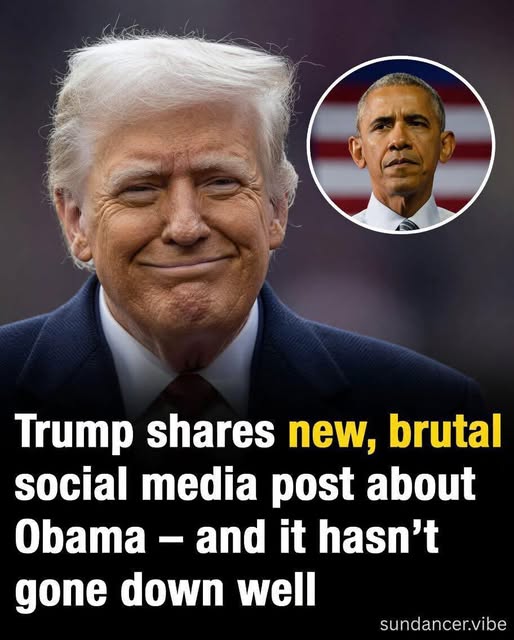
The meme didn’t just land—it detonated. A single image, deceptively simple, managed to compress years of tension, rivalry, and unresolved resentment into something instantly digestible and endlessly shareable. Two presidents, frozen in a moment that felt both staged and strangely authentic, became the centerpiece of a digital storm. When Trump reposted it, the act carried more weight than a passing joke. It read like a calculated move—a victory lap wrapped in irony, a taunt disguised as humor, a signal to supporters and critics alike that the rivalry was far from over. Within hours, timelines were ablaze. Reactions poured in faster than context could keep up. Facts bent, interpretations multiplied, and people—millions of them—gravitated toward sides, often without fully understanding the narrative they were stepping into. What began as a fleeting joke quickly evolved into a sprawling digital battleground.
But the meme revealed something deeper than a clash between two political figures. It exposed how modern politics has transformed into a continuous performance—one that never truly ends, only shifts scenes. Trump and Obama are no longer just individuals; they’ve become symbols in a broader, ongoing story that many Americans consume less as civic engagement and more as serialized drama. Every resurfaced clip, every pointed remark, every cleverly timed post becomes another episode. Old grievances are repackaged as fresh content. “Gotcha” moments are elevated into defining truths. To some, these moments signal vindication, proof that their side was always right. To others, they represent humiliation or decline. The meaning changes depending on the viewer, but the emotional pull remains constant.
Social media acts as both the stage and the amplifier. It doesn’t just host these moments—it sharpens them, rewards them, and spreads them with relentless efficiency. Algorithms favor intensity over nuance, outrage over reflection. In that environment, ambiguity becomes a powerful tool. A meme doesn’t need to be entirely true or entirely false; it only needs to provoke. Add in AI-generated visuals and increasingly sophisticated edits, and the line between sincerity and satire begins to dissolve. What’s real starts to feel negotiable, even optional.
Within this landscape, political figures are no longer just leaders making decisions—they are performers managing perception. They craft personas, revisit old rivalries, and stage moments of triumph or defiance with an audience in mind. Every post, every reaction, every silence can be part of the script. And the audience, conditioned for immediacy, responds in real time—liking, sharing, arguing, reinforcing the cycle.
The consequence isn’t always obvious, but it runs deep. As the spectacle becomes sharper, more engaging, and more addictive, the substance of governance often fades into the background. Policy discussions struggle to compete with viral moments. Complex issues are reduced to symbols and slogans. Citizens, caught in the flood of content, are left to sift through fragments—trying to distinguish signal from noise, intention from performance, truth from manipulation.
In the end, the meme wasn’t just a joke or a jab. It was a snapshot of a larger reality: a political culture where perception often outweighs substance, where narratives evolve faster than understanding, and where the question of what’s real is no longer as straightforward as it once seemed.