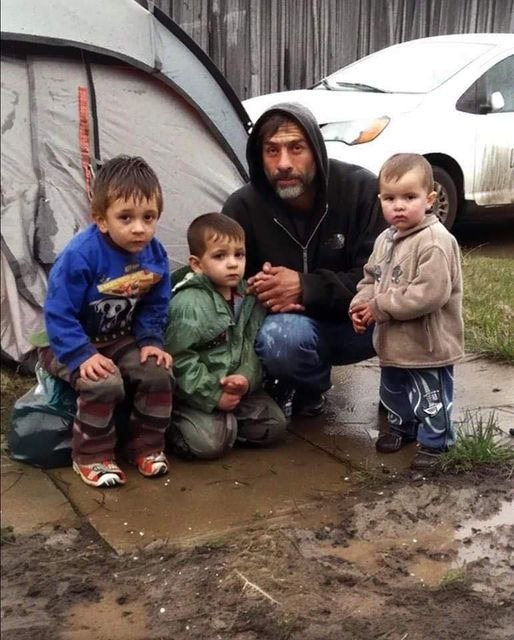
Sean had been carrying the weight of defeat long before that day on the roadside. Life had not simply tested him—it had stripped him down to the raw edge of survival. He had no job to return to, no home to shelter his family, and no certainty about what tomorrow would bring. Night after night, he lay awake listening to the restless breathing of his three hungry children, haunted by the unbearable question every parent fears: How do I protect them when I have nothing left to give? In his pocket were two crumpled dollar bills—the last two dollars standing between his family and complete desperation. To anyone else, it looked insignificant. To Sean, it was everything.
Then, on a day that seemed no different from all the others marked by struggle, a stranger’s car rolled to a stop near where Sean stood. The man looked frantic, his voice shaking as he explained that he had run out of gas and his wife was in labor, waiting helplessly while he tried to get her to the hospital. He pleaded for help, asking for enough money to buy fuel. Sean froze. His hand tightened around those two worn bills as a war erupted inside him. His mind screamed that he couldn’t do it. Those dollars might buy bread. They might help keep his children fed for one more day. Giving them away could mean choosing even deeper suffering for the people he loved most.
But something stronger than fear stirred in him.
Because even after poverty had taken nearly everything, it had not taken his compassion.
With trembling hands, Sean reached into his pocket and gave the stranger the last money he had in the world.
It felt less like generosity and more like surrender—an impossible sacrifice made in silence, with no audience, no reward, and no reason to believe it would matter. Sean believed he was making a heartbreaking choice between his children’s survival and a stranger’s emergency. What he did not know was that this moment—this quiet act of humanity offered from the depths of ruin—was being seen, weighed, and remembered by someone who was not at all what he seemed.
Days passed, and Sean returned to the same harsh reality, expecting nothing to change. But then the stranger came back.
Only this time, he did not return as a desperate man in need.
He returned as a man of extraordinary means.
The roadside encounter had been no accident. The stranger had been observing something far greater than whether Sean would hand over two dollars. He had been looking for character—for proof that even under crushing hardship, some people refuse to let suffering make them selfish. And in Sean, he had found something rare: a man who, despite losing almost everything, still chose mercy over fear.
That single act of compassion became the turning point Sean never saw coming.
The stranger offered him more than thanks. He offered him a job—steady work, honest pay, and a chance to begin again. Soon there was a roof over Sean’s family instead of a tent against the cold. There was food on the table instead of gnawing hunger. There was warmth, safety, and the long-forgotten dignity of watching his children fall asleep without fear of tomorrow. For the first time in years, Sean could breathe.
But the true miracle was not that Sean escaped poverty.
It was what he did after.
Because he never forgot where he came from.
He never forgot the freezing nights, the empty stomachs, or the helpless shame of watching his children suffer.
And he never forgot that everything changed because he gave when he had almost nothing.
As the years passed, gratitude in Sean did not fade—it transformed into purpose. He poured his earnings into helping others standing where he once stood. He funded hot meals for the homeless. He supported shelters that opened doors to families with nowhere else to go. He paid for motel rooms in winter, bought groceries for struggling parents, and offered quiet acts of rescue to people on the edge of losing hope. Often, he helped anonymously, because he understood something many never learn:
The most powerful kindness is often the kind no one sees.
Sean came to believe miracles rarely arrive wrapped in spectacle. They do not descend in flashes of light or dramatic signs. More often, they come disguised as painful choices, impossible sacrifices, and moments when doing the right thing seems to cost too much.
His story spread, not as a fairy tale about luck or reward, but as something far deeper—a testament to the hidden power of compassion. It became a reminder that character is not revealed when life is easy, but when everything is falling apart. That what you give when you have almost nothing may shape who you become when life finally gives something back.
And perhaps most of all, Sean’s story carried a quiet warning:
Never underestimate the value of a good deed done in obscurity.
Because the smallest act of kindness, offered when no one is watching, may be the very moment destiny is watching most closely.