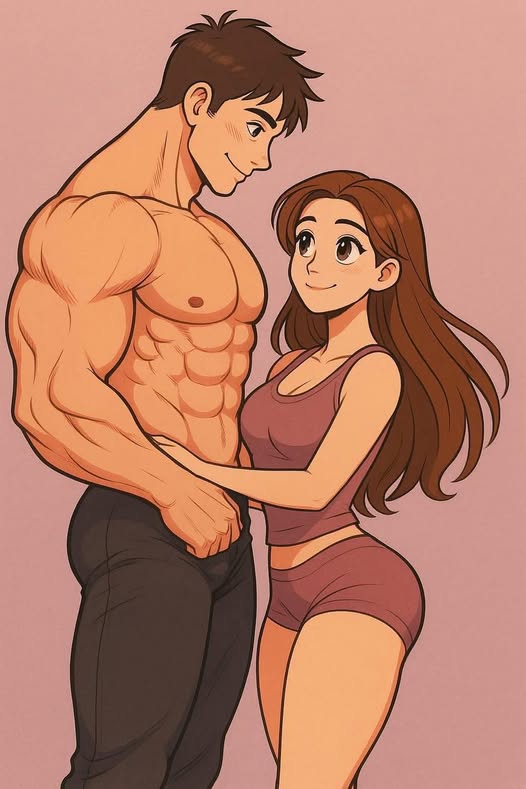
When a man first notices her, it rarely begins with her smile, her voice, or even the mystery of her name. Before any of that, something far more immediate registers in a split second—her presence. And often, that presence is shaped first by one striking, undeniable detail: her height.
Tall. Petite. Statuesque. Delicate. Towering in heels or effortlessly compact in frame—it lands in his mind before he fully realizes it has. It is instinctive, almost primal, woven into ancient perceptions of attraction, dominance, protection, desire, and status. In that instant, something subtle begins to unfold inside him. His posture shifts. His assumptions form. His fantasies start sketching themselves in silence.
He may tell himself it’s simple. I just have a type.
But what he calls a “type” is often something much deeper—something psychological, emotional, even symbolic.
Because beneath the casual language of preferences lies a hidden architecture of longing. A man’s fixation on a woman’s height often says far less about her body than it does about his inner relationship with power, security, identity, and ego.
A tall woman, for many men, carries a subconscious mythology.
She is not merely taller—she can be perceived as commanding. Elevated. Unignorable. She walks into a room and seems to alter its gravity. Whether intentionally or not, she may evoke ideas of confidence, ambition, authority, or social power. In the male imagination, she can become the embodiment of challenge.
And men drawn to that often aren’t just pursuing beauty.
They may be pursuing the thrill of standing beside a woman who feels exceptional.
They may crave the status of being chosen by someone who seems difficult to impress.
They may be drawn to the tension of courting a woman who feels, in some psychological sense, like an equal—or even a rival.
Sometimes that attraction is admiration.
Sometimes it is aspiration.
And sometimes, without realizing it, it is competition dressed as desire.
Because for some men, loving a powerful woman is not about surrendering to her strength, but proving themselves worthy of it.
And that reveals everything.
But the story changes when he is drawn to a shorter woman.
Because petite women often trigger an entirely different symbolic script.
They are, fairly or unfairly, often unconsciously associated with softness. Warmth. Gentleness. Emotional safety. They can evoke protectiveness, tenderness, even a desire to shield and provide.
And men who consistently gravitate toward that may not simply be responding to physical proportions.
They may be seeking emotional refuge.
They may long for a relationship that feels calming rather than challenging.
They may be drawn to dynamics where masculinity feels affirmed through protection and caretaking.
Or they may simply want love to feel safe.
Not performative.
Not competitive.
Safe.
And sometimes, beneath that preference, sits an unspoken insecurity—a desire for a relationship where he feels larger, stronger, more certain of his role.
Again, the attraction is real.
But it often carries meaning far beyond aesthetics.
Because whether a man wants to tower over her or be intrigued by being physically dwarfed by her, he is often revealing something intimate about how he wants to feel in love.
Powerful.
Needed.
Admired.
Protected.
Challenged.
Calmed.
Validated.
Desired.
Height, in this sense, becomes less about inches and more about emotional architecture.
A tall woman may awaken his hunger for intensity.
A short woman may awaken his longing for peace.
A woman his own height may stir something else entirely—partnership, balance, symmetry.
None of these desires are inherently shallow.
None are inherently wrong.
But all of them can function as mirrors.
Because what attracts us physically often points toward what we are negotiating psychologically.
The man obsessed with being taller may be guarding a fragile sense of dominance.
The man enchanted by taller women may secretly be drawn to surrender.
The man who insists height “doesn’t matter” may still be shaped by it in ways he has never examined.
That is why what looks like preference is often revelation.
What looks like chemistry can sometimes be biography.
And what feels like instinct may actually be the quiet expression of old emotional needs.
In the end, height is just a number.
But the meanings a man attaches to it—consciously or unconsciously—can reveal his fears, his fantasies, his insecurities, and the role he wants love to let him play.
Because when he says, I like tall women, or I only date petite women, he may think he is describing her.
But often—
he is describing himself.