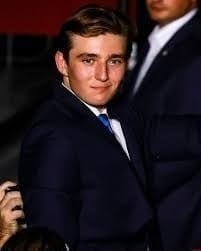
For nearly two decades, the American public believed it had Barron Trump figured out. A silent figure in the background. A reserved presence standing just outside the glare of history. An enigma, perhaps—but one that seemed easy to define from a distance. It turns out that assumption couldn’t have been more wrong.
He was never simply the quiet son trailing behind power. Never just the still image captured at ceremonies and state appearances. While the world projected its narratives onto him—awkward, sheltered, secondary—he was doing something far less visible and far more deliberate. He was observing. Absorbing. Measuring the weight of expectation placed upon him long before he had any say in the matter. And, above all, he was waiting.
Now, standing at the threshold of adulthood, Barron Trump is no longer content to exist as a reflection of other people’s assumptions. Without theatrics, without spectacle, he has begun to assert something far more powerful than rebellion: independence. His emergence isn’t marked by grand declarations or calculated headlines, but by something quieter—and in many ways, more unsettling. A composed, deliberate refusal.
A refusal to inherit a role he did not choose.
A refusal to fulfill a narrative written before he could speak.
A refusal to become a symbol in a story that was never his.
There is no dramatic unveiling, no carefully staged reinvention. Instead, what we see is a young man stepping forward with a clarity that feels almost disarming in its simplicity. No promises of political ambition. No gestures toward legacy-building. No attempt to capitalize on the weight of a name recognized across the globe. Just a steady, unmistakable message: he will define himself on his own terms, in his own time.
In a culture obsessed with visibility—where relevance is measured in clicks, appearances, and constant exposure—this choice feels almost radical. Barron is not chasing attention; he is actively rejecting it. Where others might leverage proximity to power into influence or opportunity, he appears to be doing the opposite. Choosing privacy over performance. Introspection over immediacy. Distance over display.
And that is precisely what makes his stance so compelling.
He is not denying who he is. He is not pretending his last name carries no significance, no history, no expectation. He understands it—perhaps more deeply than most. He recognizes the gravity of it, the assumptions it invites, the future it seems to prescribe. But instead of allowing that weight to define him, he is quietly resisting it.
Not with defiance, but with intention.
In doing so, he disrupts a pattern that has become almost predictable: the children of influence stepping forward to extend, amplify, or repackage the legacy they inherit. Barron’s approach is different. He is not interested in becoming an extension of anything. He is carving out the right to remain undefined, to exist without immediate categorization, to build a life that unfolds beyond the reach of public expectation.
There is something almost paradoxical about it. In saying so little, he communicates so much. In stepping back, he asserts control. In choosing absence, he creates presence.
And perhaps that is the most striking element of all: the quiet confidence of someone who understands that identity is not something owed to the public, but something earned privately, over time.
His message, though unspoken, lands with unmistakable force:
You may recognize the name. You may feel entitled to the story.
But you do not own the person who carries it.