The political world was jolted by a wave of incendiary rhetoric attributed to Donald Trump, whose remarks painted an almost apocalyptic vision of global conflict. In his words, the scale of destruction being discussed reached the level of a “whole civilization” being wiped out in a single night—language that immediately sparked alarm across political circles and international observers alike. References to Iran being “pushed back to the Stone Age,” cities reduced to darkness, bridges destroyed, and entire populations erased in a flash of overwhelming force spread rapidly, fueling fears of an escalation far beyond conventional geopolitical threats.
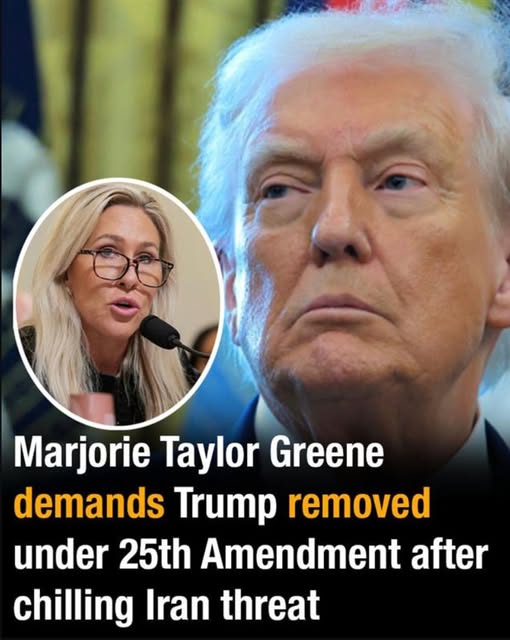
What made the moment even more politically explosive was not only the severity of the rhetoric itself, but the reaction it triggered from within Trump’s own political camp. Former staunch ally Marjorie Taylor Greene reportedly broke ranks in a dramatic and unexpected way, calling for the invocation of the Twenty-Fifth Amendment. She described the rhetoric and direction of events as “evil and madness,” a stark condemnation that underscored the depth of her concern and the widening fissures inside a movement long known for its loyalty to Trump.
The clash of narratives exposed a rare and unsettling fracture: a president speaking in language of total annihilation, and a prominent supporter warning that such rhetoric signals a dangerous instability at the highest levels of power. For critics, this moment was not simply political theater—it was evidence of a broader anxiety about the limits of executive authority when confronted with the possibility of catastrophic military escalation.
Amid the uproar, however, another development added further complexity to an already volatile situation. Reports indicated that Trump also agreed to a conditional two-week ceasefire framework with Iran, citing that U.S. “military objectives” had been largely achieved. Under the arrangement, shipping lanes through the Strait of Hormuz were expected to reopen with coordination from Iranian authorities, offering a temporary easing of tensions in one of the world’s most strategically sensitive waterways.
Yet this fragile pause did little to calm the broader uncertainty. Between threats of overwhelming retaliation and sudden gestures toward de-escalation, the situation has been described as a precarious balancing act—one where rhetoric and diplomacy appear to pull in opposite directions. Observers are left grappling with a haunting question: is this calculated brinkmanship designed to force concessions, or a sign that the traditional guardrails restraining presidential war powers are far weaker and more fragile than previously believed?