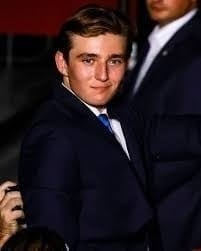
For eighteen years, America thought it knew Barron Trump. The image was simple, almost cartoonish: the quiet, awkward boy trailing behind a president, a shadow cast by the glare of history and headlines. Observers assumed he was just a passive presence, a child who would inevitably grow into the story his last name demanded. But they were wrong. Far from being a silent observer, Barron has been watching, calculating, and—most crucially—waiting.
Now, on the cusp of adulthood, he has emerged from the margins not with fanfare or spectacle, but with a calm, unnervingly precise declaration: the life the world wrote for him is not his to live. There will be no dynastic coronation, no scripted political prophecy, no carefully choreographed passage into the public eye. Instead, he offers something far more radical: a refusal. A refusal to be defined by lineage, by expectation, or by the relentless machinery of public imagination. Behind closed doors, away from the flashbulbs and the soundbites, Barron is staking a claim to himself—and only himself.
What makes this emergence so striking is its quiet severity. There is no tantrum, no provocation, no attempt to shock. In a culture addicted to access, curated moments, and performative transparency, his act of withdrawal is itself revolutionary. Barron is rejecting the script that has shadowed him since birth: the heir apparent, the symbol of continuity, the next-generation combatant in America’s perpetual political wars. Instead, he insists on ambiguity. He insists on the right to be unfinished, unpolished, unknowable. His future will not be dictated by pundits, tweets, or partisan fantasies—it will be his alone.
And yet, this is not escapism. He does not pretend that his last name is ordinary. He does not deny the weight, the scrutiny, the legacy. He acknowledges it, fully and without flinching, and then refuses to let it shape him into a predictable mold. In a world where the children of the powerful are often compelled to monetize every gesture, every milestone, Barron chooses absence over performance, authenticity over spectacle. His message resonates because it carries emotional clarity: you may know the name, you may recognize the face, but you do not own the person who bears it.
In that quiet, deliberate refusal lies a deeper power—a reminder that the truest assertion of freedom may not be loud rebellion, but the unshakable insistence on living on one’s own terms. Barron Trump, at the threshold of adulthood, is not just stepping away from expectation; he is quietly redefining what it means to inherit not a legacy, but the right to define oneself.