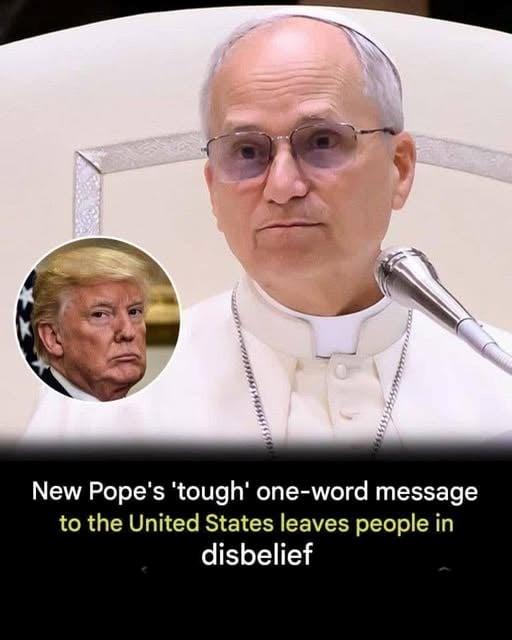
The world seemed to pause for a single whisper.
One word. Eight letters. A papal reply that cut through the clamor of American chaos like a surgeon’s scalpel. As politicians raged on cable news and pundits spun their endless cycles of outrage, Pope Leo XIV offered an answer to a question no one dared ask directly: What has become of this nation, so fractured, so restless, so at war with itself? And the word came, quiet but impossible to ignore: “Many.”
It was not a dodge. It was not a clever sidestep. It was both indictment and invitation, accusation and mirror. In that single syllable, Leo XIV held up a reflection of America not as it wanted to be seen, but as it truly was: messy, conflicted, and painfully entangled in its own contradictions.
What made “Many” unforgettable was not its economy of language, but the weight behind it. This was a man who had walked through refugee camps where despair was a constant companion, who had confronted world leaders with unflinching honesty, who had knelt beside the graves of the forgotten and unseen. Leo XIV did not offer comfort; he offered clarity. In that one word, he cataloged not only the number of crises that beset the nation, but the depth of our moral, political, and spiritual entanglement. He refused to pander to narratives or soften the truth for convenience. He placed responsibility where it had always belonged: squarely on the conscience of a people too often distracted by argument, spectacle, and self-interest to confront what truly demanded reckoning.
And yet, “Many” was not a sentence of despair. Hidden within its austerity was a faint, almost imperceptible pulse of hope. Many chances remain to rebuild, many neighbors still worth defending, many borders that could be transformed into bridges instead of battle lines. By speaking so little, Leo XIV opened the conversation to something far larger than politics: to conscience, to courage, to the enduring challenge of living rightly in a world stubbornly resistant to change.
After his whisper, the question no longer lingers as a puzzle of grammar—no longer “Many what?” It has become a question of destiny, of action, of moral urgency: How many more—how many mistakes, betrayals, and moments of indifference—before we finally summon the will to change?
The echo of that single word refuses to fade. It hovers over debates, over decisions, over every act that might define the future of a nation. And in that quiet resonance, there lies both challenge and invitation: to see clearly, to act boldly, and to reckon, at last, with the truth that has always been waiting for us.