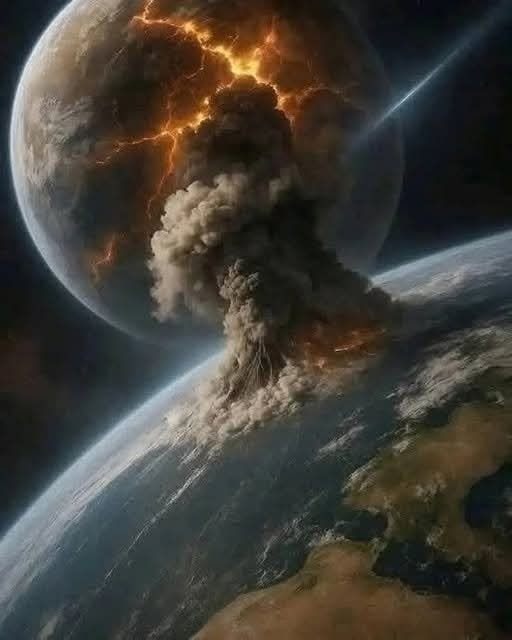
The warning didn’t sound like a warning at all. It arrived hidden beneath layers of technical jargon, couched in the sterile, familiar language of routine bulletins. Another asteroid, another flyby, another cosmic pebble drifting harmlessly past our planet—so the message implied, so the calm graphs and measured diagrams suggested. Yet, as the words unfolded, a subtle dissonance began to ripple through the professional composure. The numbers weren’t small. They weren’t meters or hundreds of meters. They were kilometers. Whole kilometers stretching across the void, and suddenly the veneer of safety cracked. A mountain-sized asteroid, gliding silently through the solar system, was threading a path closer to Earth than anything we had imagined—close enough to erase illusions, close enough to force an uneasy awareness of our fragility.
Its name is a sterile, catalog-like string of numbers: 52768 (1998 OR2). Nothing heroic, nothing ominous—just a digital designation in a database that holds thousands like it. Yet behind the clinical label lurks something that could command awe, or terror: estimates place it somewhere between 1.5 and 4 kilometers across, drifting through the cosmic darkness with a patience and indifference that mock human schedules and safeguards. Meanwhile, back on Earth, a cadre of scientists tracks its trajectory with obsessive precision, measuring the asteroid’s motion down to fractions of a second, running endless simulations across arrays of computers, double-checking, recalculating, triple-checking. Their conclusion is reassuring—this time. This asteroid will miss. There will be no collision, no apocalyptic shockwave, no sudden global eclipse of destruction. The planet will remain as it always has, spinning obliviously through space, while this silent behemoth passes by like a ghost through a cathedral of stars.
Yet even in that relief, a shadow lingers. Its passage, calculated and confirmed, reveals a deeper, more uncomfortable truth: humanity’s security is provisional, fragile, contingent on what we happen to notice, in time to act. Detection networks, funding cycles, political will—all these are thin shields against the universe’s indifference. Today, the math comforts us. Tomorrow, an asteroid might appear smaller, faster, less predictable, closer. It could slip past unnoticed until the moment it cannot be avoided. And with every “no danger” headline, every televised reassurance, a quiet question hovers, unspoken but insistent: what happens when the numbers suddenly tilt, when certainty fractures, and the next visitor from the void does not read our calendars, heed our warnings, or respect our boundaries?
For a fleeting moment, Earth feels smaller. Our bustling cities, our confident technologies, our sense of dominion—all of it reduced to a single, silent truth: the cosmos does not negotiate, it does not wait, and it never apologizes. And somewhere out there, in the endless black, 52768 (1998 OR2) drifts on, indifferent, magnificent, and entirely beyond our control.