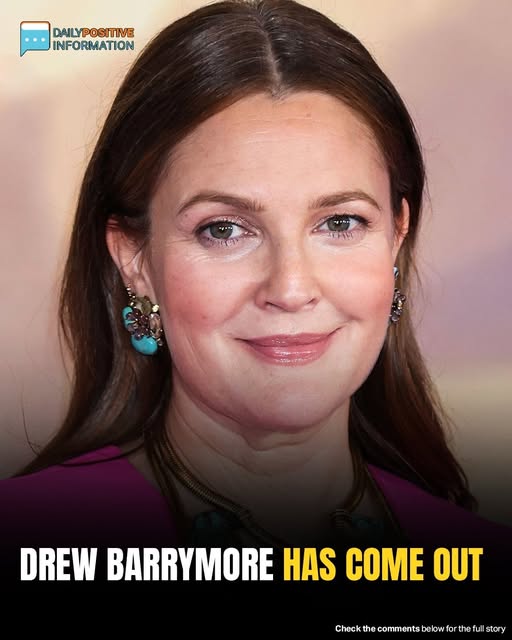
Drew Barrymore’s truth didn’t simply slip into the conversation—it landed like a quiet explosion that echoed far beyond the studio lights. For decades, the world believed it already knew her story. She had grown up before the public eye, laughed through interviews, cried through heartbreaks, and rebuilt her life again and again under relentless scrutiny. Yet even after all those years in the spotlight, there remained one deeply personal truth she had guarded with extraordinary care.
When she finally spoke the words—“I’ve always considered myself bisexual”—it wasn’t delivered with drama or spectacle. It came with the same warmth and honesty that has defined her later years. But behind that calm admission lay a lifetime of reflection, confusion, curiosity, and quiet courage. The cameras captured her smile in that moment, but they couldn’t capture the decades of self-discovery that had shaped it.
For someone raised in the relentless glare of Hollywood, Barrymore’s openness felt less like a shocking confession and more like a powerful act of reclaiming her own narrative. Her life has been one of the most public journeys in modern celebrity culture. Audiences first met her as a bright-eyed child star in E.T. the Extra-Terrestrial, a role that instantly turned her into one of the most recognizable children in the world. Fame arrived early—and with it came pressures few children could possibly understand.
The years that followed were anything but simple. Barrymore’s adolescence was marked by rebellion, vulnerability, and a very public struggle to find stability. She battled addiction, navigated fractured family dynamics, and endured the painful process of growing up under the constant gaze of the media. Many people expected her story to end there—as a cautionary tale of child stardom gone wrong.
But Barrymore refused to let that be her legacy.
Instead, she rebuilt her life piece by piece, eventually emerging as not only a successful actress but also a producer, entrepreneur, and beloved talk-show host on The Drew Barrymore Show. Along the way, she experienced love in many forms—romantic relationships that blossomed and faded, three marriages that each taught their own lessons, and the transformative experience of motherhood, which she often describes as the most grounding force in her life.
Through all of it, she carried a private understanding of herself that she rarely discussed publicly. Her acknowledgment of bisexuality was not a sudden revelation but something she had long recognized within herself. In speaking about it openly, she made it clear that her identity was never about fitting into a label or creating headlines. It was simply about acknowledging the full truth of who she has always been.
Barrymore spoke candidly about her appreciation for women’s beauty and the complexity of human connection. For her, attraction was never confined to a rigid category. Love, she suggested, exists in many forms, and the human heart rarely obeys the neat boundaries society tries to draw around it.
What makes her words resonate so deeply is not just the statement itself, but the context of the life she has lived. Millions of people have watched Barrymore grow up—from the precocious child star to the rebellious teenager, from the resilient young woman rebuilding her career to the reflective adult who now radiates a kind of hard-won peace. Her honesty arrives not from a place of rebellion, but from a place of self-acceptance.
For many fans, particularly those who spent their own formative years watching her films, Barrymore’s openness carries a quiet but powerful message. It reminds people that identity is rarely simple and that understanding oneself can take a lifetime. Her willingness to share her truth transforms her personal journey into something much larger than celebrity news.
It becomes a mirror for others.
In a culture where public figures often feel pressured to present polished, carefully curated versions of themselves, Barrymore’s vulnerability stands out. She doesn’t frame her sexuality as a dramatic reinvention or a new chapter designed to shock audiences. Instead, she presents it as something that has always been part of her story—an aspect of herself that she simply no longer feels the need to hide.
That subtle shift carries enormous meaning.
For countless people quietly navigating their own questions about identity, hearing someone like Barrymore speak with such calm assurance can feel deeply validating. Her story suggests that self-discovery doesn’t have an expiration date, and that embracing one’s truth doesn’t require perfection or certainty—only honesty.
In the end, Barrymore’s revelation is less about sexuality and more about authenticity. After decades spent performing for the world, she has reached a stage of life where she no longer feels the need to edit herself for anyone else’s comfort.
And in doing so, she offers something far more powerful than a headline.
She offers permission.
Permission for others to explore their own identities without shame. Permission to evolve, to question, to grow. Permission to live openly, even if the journey there is messy, complicated, and unfinished.
Because if there is one thing Drew Barrymore’s life has proven, it is that the most courageous act a person can take—especially in the blinding glare of fame—is simply to tell the truth about who they are. 🌟