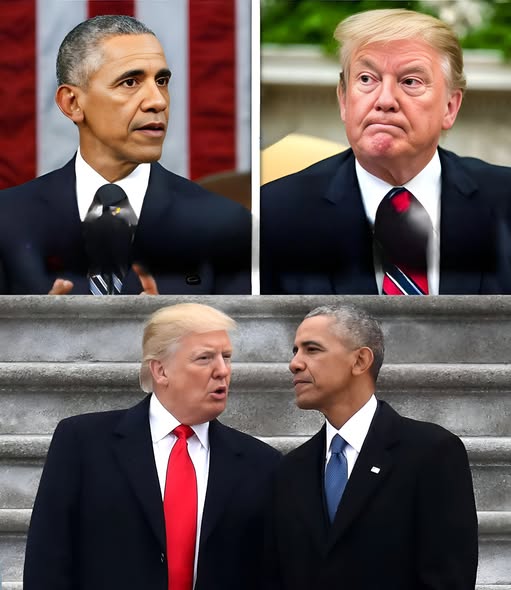
The moment Donald Trump fixed his gaze on Barack Obama, the atmosphere in the studio shifted in an instant. Cameras continued to roll, lights blazed, but a chill seemed to pass over the room, palpable to everyone present. What had begun as a routine interview—the kind designed to fill airtime without incident—suddenly morphed into something far more intense: a raw, personal confrontation broadcast across the nation, every word dissected by millions. Viewers at home froze, caught between disbelief and fascination, as Trump’s pointed critique cut into the carefully curated memory of a former president. Within moments, social media erupted in a frenzy, fracturing the country into opposing camps, each insisting they alone understood the truth behind the exchange.
What was supposed to be a simple segment on policy and legacy instead became a defining snapshot of modern American politics: unfiltered, strategic, and weaponized in real time for an audience that craves immediacy above all else. Trump’s criticism of Obama went beyond mere reflection on the past; it was a meticulously staged performance for a nation already polarized, designed to dominate headlines and feeds alike. Supporters praised his audacity and perceived honesty, while critics lamented the erosion of civility, framing it as a symbolic collapse of decorum. Millions replayed the clip, pausing, rewinding, and scrutinizing every inflection, gesture, and expression, hunting for hidden meaning as though each micro-moment held the key to the national debate itself.
But the story runs deeper than viral soundbites or trending hashtags. This confrontation revealed a tectonic shift in how politics is conducted and consumed: the fusion of live television and social media into a single, unpredictable arena where perception outruns context, and outrage often overwhelms reason. It laid bare a harsh reality: leadership in the modern era is judged not only by the substance of policy but by the spectacle of conflict—by who frames it, how it spreads, and what lingers in the public imagination long after the broadcast ends. In that sense, this interview was not merely an anomaly or a shocking episode—it was a warning, a preview of the new political landscape, and a demonstration of how easily the collective consciousness can be pulled along, swept up in the velocity of outrage, commentary, and instant interpretation.
In the end, the exchange between Trump and Obama was more than a clash between two political figures. It was a reflection of a nation grappling with its own media-driven mirror, confronting the ways in which power, perception, and performance now define the rules of engagement—and reminding us all that in this new age, what we see is rarely just what it seems.