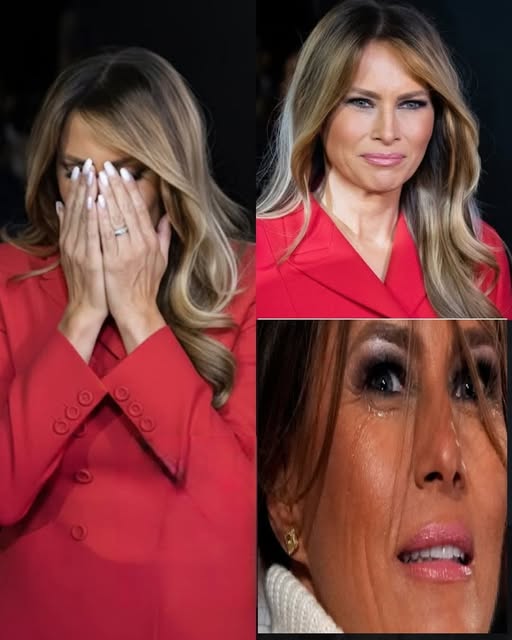
The words from Melania Trump did not arrive as a political statement. They arrived as something far heavier—something that felt closer to grief itself. Her message moved through the stunned silence that followed a tragedy too sudden for the mind to absorb. A young father is gone. A crowded auditorium that only moments earlier buzzed with anticipation now echoes with memories of screams, confusion, and disbelief. Across the country, people stare into a darkness they cannot quite explain, asking how a life filled with ambition, family, and purpose could vanish in a single, violent moment.
In homes far removed from the scene, the loss feels strangely intimate. Children will reach out for a voice that will never answer again. A wife will lie down at night beside an absence no vow was ever meant to face. Friends who once laughed with him will replay their final conversations, wondering if they somehow missed the fragility hidden beneath ordinary days. What remains is a silence that feels almost physical—heavy, stubborn, impossible to ignore.
The assassination of Charlie Kirk sent shockwaves far beyond the campus of Utah Valley University. Nearly three thousand people were present when the unthinkable unfolded, watching a moment that will be etched into memory for the rest of their lives. For those in the auditorium, time seemed to split into two parts: the world before the shots, and the world after them. But as the news spread, it was Melania Trump’s quiet and deeply human tribute that pierced through the noise of headlines, commentary, and political analysis.
She did not speak about ideology, strategy, or influence. Instead, her words drifted toward the spaces where grief truly lives—the kitchen table, the family photographs, the bedtime routines that will now carry an unbearable emptiness. She spoke about children who will grow up searching for their father in stories others tell them. About a home where laughter once bounced off the walls but will now be replaced by a ringing, unforgiving quiet. Her message was not loud, but it carried a weight that forced the nation to pause.
In her tribute, Kirk was not presented as a figure in the center of political storms or public debates. He was described as something far simpler and far more profound: a husband who returned home tired but still present, a father who bent down to listen when his children spoke, a man who believed that loving one’s country began first with loving one’s family. Those small, ordinary details—so often invisible in public life—suddenly became the most important parts of his story.
Melania’s message gently urged Americans to see beyond the labels and arguments that often divide them. She asked the country to remember the fragile humanity that exists behind every public figure, every headline, every disagreement. In doing so, she transformed a shocking public tragedy into something deeply personal—a plea for compassion, awareness, and reflection.
Because beneath the noise of politics and the rush of breaking news lies a simpler truth: a family has lost its center. Children have lost their father. A home has lost its laughter. And a nation, if only for a moment, has been reminded of how fragile every life truly is.
Her final sentiment lingered like an echo: that honoring a life cut short should not begin with anger or division, but with something far more difficult and far more necessary—recognizing one another’s humanity before it is too late. 🕯️💔🇺🇸