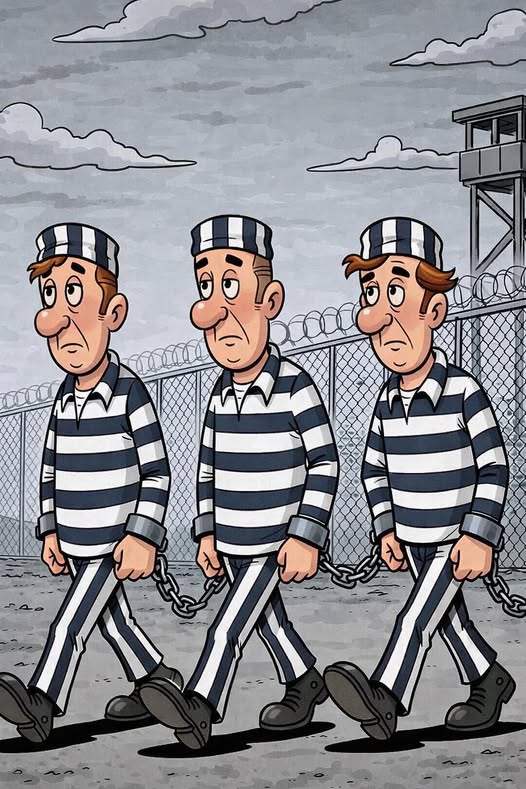
The bus was silent in that heavy, almost unnatural way only shared transport to prison can be—metal seats, restrained wrists, and men pretending they aren’t thinking about how long forever feels. Then, without warning, the silence cracked.
It started with a laugh. Then a second. Then a punchline so absurd it didn’t belong in a place like this at all.
Three convicts sat chained in the same row, each serving long sentences and each carrying one “essential item” they believed would somehow make years behind bars bearable. What they chose said more about them than their crimes ever could.
The first was a man who believed survival meant creation. He spoke softly about painting—about colors, brushes, and imaginary galleries where his name might one day hang in quiet admiration. In his mind, even prison walls couldn’t fully trap someone who could still imagine beauty.
The second lived in a different kind of escape. He smiled too often, too quickly, like someone always waiting for the next roll of the dice. He talked about games of chance, about systems and luck, as if probability itself might someday negotiate his freedom.
And then there was the third.
He carried something so unexpectedly strange, so hilariously misinterpreted, that both men beside him froze the moment they saw it. No explanation helped. No logic softened it. It was the kind of mistake that shouldn’t survive even five minutes of prison scrutiny—and yet there it was, tucked away like a secret that refused to behave.
For a while, none of them spoke. The bus rumbled forward, carrying them deeper into a future none of them wanted to describe out loud.
Then night came.
The windows darkened. The overhead lights flickered and died, leaving only shadows and the sound of chains shifting. Someone in the back shouted a number into the darkness—a coded joke, thrown like a spark into dry air.
For a second, nothing happened.
Then the entire bus erupted.
Hardened men—people who had survived violence, betrayal, and years of locked doors—collapsed into uncontrollable laughter. It wasn’t just amusement. It was release. The kind of laughter that hurts your ribs and surprises you at how human you still are.
And in that chaos, something quietly shifted.
Because inside those walls, humor had become its own language. A survival system. A way to turn fear into something that could be carried instead of swallowed whole.
By the time they reached the prison block, the jokes had already evolved into something stranger still—numbers. Simple codes shouted across cells that made no sense to outsiders but carried entire histories of pain and irony for those inside.
Even men who had heard every joke imaginable still needed it. Still craved it. Still clung to it.
Then the newcomer arrived.
He hesitated, listened, tried to understand the rhythm of this coded world—and finally, nervously, he shouted a number of his own.
“Twenty-nine.”
For a split second, there was silence again. The kind that feels like judgment.
And then it hit.
The reaction wasn’t gradual—it exploded. Laughter erupted from every corner of the cell block, echoing off concrete and steel. Men doubled over, banging walls, wiping tears from their eyes. Not because the number itself was funny—but because it was new. Unexpected. Perfectly timed in a place where nothing ever felt new again.
And in that moment, the newcomer realized something he hadn’t expected at all.
Inside prison, even joy has rules. Even humor has history. But sometimes, just sometimes, a single voice can break through the repetition—and remind everyone listening that surprise still exists, laughter still survives, and humanity hasn’t been completely locked away.