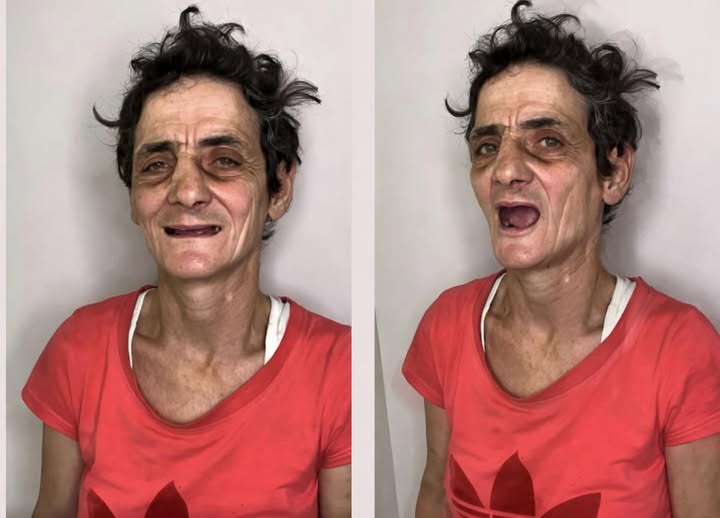
Rita had already lost almost everything that once defined her.
Her son was gone. Her home had vanished. The life she once knew—ordinary, stable, predictable—had quietly collapsed into silence and absence. And in its place came something far harsher: invisibility.
Day after day, she moved through the streets like a shadow that no one quite acknowledged. People passed her without a glance, or worse—with a glance that looked right through her. She collected bottles, survived on scraps of kindness or luck, and learned how to make herself smaller in a world that no longer seemed to have space for her. Not because she wanted to disappear—but because the world had already decided she had.
Then, one day, something changed.
A stranger stopped.
Not in pity. Not in discomfort. But in attention.
And for the first time in a long time, Rita was not looked past—she was seen.
What happened next was not a grand rescue or a dramatic miracle. There were no headlines, no flashing lights, no sudden transformation meant to impress the world. Instead, it was something quieter—and far more powerful.
It was dignity, carefully restored piece by piece.
A dentist’s chair where someone treated her pain as real and worth fixing.
Gentle hands that didn’t rush her, but instead listened to what her body had endured.
A patient moment as her hair was carefully washed and cared for, as if she mattered again.
The soft attention of someone cleaning and painting her nails—not as decoration, but as a reminder that she was still a person worthy of care.
Each small act carried a message louder than words ever could:
You are not forgotten. You are not beyond hope. You still matter.
For someone like Rita—who had been ignored for so long that invisibility had become normal—those gestures were not simple kindness. They were revolutionary. They pushed back against years of abandonment, telling her, slowly and insistently, that she did not have to disappear completely.
And something inside her began to respond.
It didn’t happen all at once. Healing rarely does.
But as she looked at her reflection, something softened. Not perfection—but recognition. A flicker of the woman she used to be, and perhaps even someone she could become again.
Her grief did not vanish. It stayed with her, as grief often does. But it no longer stood alone.
Beside it, something new began to grow.
Possibility.
She started to stand a little straighter. To hold eye contact a little longer. To let herself breathe in spaces where before she would have shrunk away. And slowly, almost cautiously, she allowed herself to imagine something she had long stopped believing was possible: that she might not only survive—but belong again.
Rita’s story is not about a single moment of rescue. It is about what happens when someone refuses to treat another human being as invisible. It reveals how fragile the line is between abandonment and belonging, and how easily a life can slip into the margins—or be guided gently back from them.
In the end, it was not wealth, or power, or spectacle that changed her path.
It was something simpler.
A quiet, stubborn act of human kindness that said, without conditions or expectations:
You are still here. And that is enough to begin again.