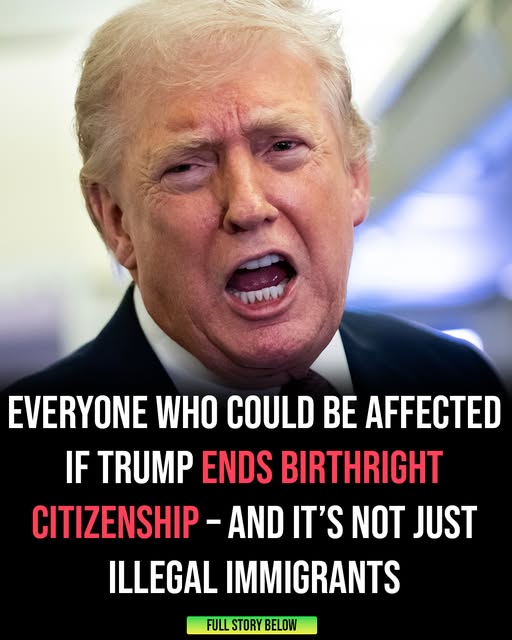
What’s unfolding around Donald Trump’s push to reshape birthright citizenship is not just another immigration debate—it feels like a constitutional shockwave moving through the foundation of modern America.
At the center of the controversy is a proposal that would fundamentally reinterpret one of the most enduring principles in United States law: the idea that anyone born on U.S. soil is automatically a citizen, regardless of their parents’ immigration status. For generations, that promise has defined what it means to belong. Now, it is being challenged in a way that could redraw that boundary inside hospital delivery rooms.
Under the proposed executive order, citizenship would no longer be guaranteed by birthplace alone. Instead, a child’s legal status could depend on their parents’ paperwork at the moment of birth. Undocumented families would be directly affected, but so would those who are legally present on student visas, work permits, or even short-term tourist stays. Families who followed every rule they were given could suddenly find themselves in legal uncertainty, with newborns potentially classified as non-citizens in the only country they have ever known.
Supporters frame the move as a correction to what they see as loopholes in the system. But critics argue it represents a dramatic break from a principle rooted in the aftermath of the Civil War and enshrined in the 14th Amendment—a clause widely understood to guarantee citizenship to nearly all individuals born in the country.
The backlash has been swift and intense. A coalition of state attorneys general has warned that such a policy would create an entirely new class of people: individuals born in America, raised in America, but permanently denied full recognition as Americans. Their argument is that the Constitution’s language is clear, and that redefining it through executive action risks destabilizing a settled interpretation that has endured for more than a century.
Now the issue is moving through the courts, with the Supreme Court positioned as the ultimate arbiter. The outcome could reshape not only immigration policy, but the very definition of citizenship itself. Beyond the legal arguments lies a deeper question echoing through the national conversation: whether America will continue to uphold a birthright rooted in equality—or allow political pressure to redraw the meaning of belonging from the moment life begins.